

The RR-20 Content Audit Framework
Last Updated: 09 July 2026 Review By: Mrinal Kaushik
In Brief
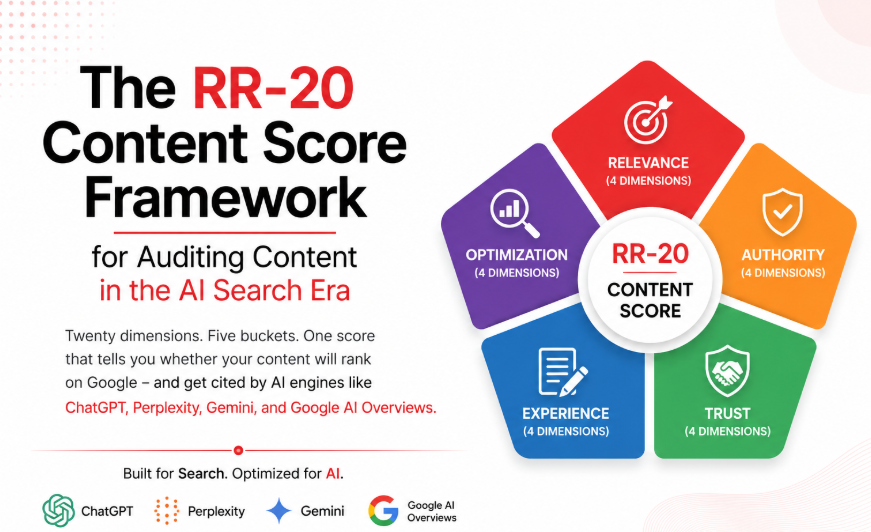
The RR-20 Content Audit Framework is a 20-dimension website content audit system organized into 5 weighted buckets: AI Citability (35%), Authority and Trust (20%), Foundation (15%), Experience (15%), and Conversion (15%). Each dimension is scored 1–10 against a defined rubric - functioning as a built-in content score checker - and the weighted total produces a single SEO content score that indicates whether a page is built to rank on Google and be cited by AI engines. We tested it on our own service page and lifted the score from 4.4 to 9.3 in a single rewrite.
The way users find businesses has changed twice in the last three years. First, AI Overviews started eating organic clicks. Then ChatGPT, Perplexity, Gemini, and Claude turned into discovery engines in their own right. Most content audits in 2026 still ask 2018 questions – meta tags, keyword density, page speed. They no longer correlate with revenue. The RR-20 Content Score is the framework we built at Redefine ROI to ask the right questions instead.
Why We Built Another Framework for Content Audit?
There is no shortage of SEO audit checklists. Most of them do not contain the checklist essential for content to be citable by AI engines.
If you run a typical web content audit in 2026 – the kind a Screaming Frog crawl or a generic content audit tool produces – you get a 47-tab spreadsheet of meta-tag warnings, broken-link reports, and Core Web Vitals failures. You fix everything. Your rankings move slightly. Your revenue does not. The content audit process confirmed what was technically wrong with the page, but it never asked whether the page was built for the AI search era.
The buyer is in ChatGPT now. The competitor is being cited in Perplexity. The client is asking why their service page does not show up in Google AI Overviews. None of those questions appear on a 2018 audit.
So we built a framework that asks them. The RR-20 Content Audit Framework has been our internal scorecard for every Redefine ROI client engagement over the past 9 months. It started as a Google Sheet with twelve dimensions. It is now a documented methodology with twenty, weighted in a way that reflects what actually moves rankings and citations in 2026.
We are publishing it because frameworks compound. Every time the methodology gets named in a Reddit answer, a podcast, or another agency’s audit deliverable, the framework strengthens. And because publishing the rubric raises the floor of content marketing audit quality across the Indian SEO market, which is good for everyone who cares about doing this seriously.
A score is only useful if you know what it tells you to do next. Most audit tools produce a number and stop. The RR-20 framework for audit content gives you a number and a prioritized fix list.
What the RR-20 Content Audit Actually Measures?
The framework looks at twenty distinct dimensions of content quality, organized into five weighted buckets. Each dimension is scored on a one-to-ten scale against a defined rubric – making the RR-20 a practical content scoring tool as much as a strategic framework. The weighted total is the final RR-20 Score, also on a one-to-ten scale.
35%
AI Citability
20%
Authority & Trust
15%
Foundation
15%
Experience
15%
Conversion
Within each bucket, the dimensions carry individual weights. A 9/10 on GEO/LLM Citability (12% of the total) contributes more to the final score than a 9/10 on Internal Linking (2%). The full weight table is in the dimensions section below.
All 20 Dimensions, Organized by Bucket
Most SEO audit frameworks weight every dimension equally, or weight Foundation work most heavily. The RR-20 does the opposite. We weight AI Citability at 35% and Foundation at 15%, and we do this deliberately.
Each dimension has a one-line definition. The full scoring rubric – including 1–3, 4–6, 7–8, and 9–10 criteria for every dimension lives is in the downloadable methodology document and scorecard.
We keep AI Citability above every other bucket because it is the dimension most agencies are not measuring at all. If two pages tie on every other axis but one of them is structured for AI extraction – direct-answer paragraphs, FAQPage schema, named first-party data, proper E-E-A-T signals – the AI-citable page will be cited in ChatGPT and Perplexity answers. The other page will not. That is the entire ball game now.
How easily an AI engine can extract a clean, attributable answer from your page. Direct-answer openings, structured H2/H3, FAQPage schema, named claims.
Presence of first-party data, proprietary frameworks, or contrarian takes that cannot be found elsewhere on the web. The single highest-leverage GEO signal.
Every numeric claim sourced inline with publication, year, and a link. AI engines preferentially cite sourced content; unsourced claims damage E-E-A-T.
Visible "Last Updated" timestamps, refreshed examples within 6 months, dateModified schema. Retrieval-augmented LLMs deprioritize stale pages systematically.
Visible Experience, Expertise, Authoritativeness, and Trustworthiness signals. Named author with bio, photo, LinkedIn, credentials, and Person schema.
Concentration of credibility cues: named testimonials with results, verified review platforms, quantified social proof, awards, certifications.
Whether the page covers the topic with semantic completeness — sub-topics, entity coverage, comparable to or beating top-3 competitor average.
Logical document structure: hierarchy, scannable sections, paragraphs of 2–4 lines, pyramid layout with TL;DR first.
Semantic correctness: one H1, descriptive keyword-aligned H2s, no skipped levels, no styling-disguised headings.
Title tag, meta description, and URL slug optimized for both ranking (keyword presence) and CTR (compelling promise).
Full schema stack appropriate to page type: Article/Service + FAQPage + BreadcrumbList + Organization + Person, validated.
Quality and density of contextual internal links with descriptive anchors, mapped to a documented pillar-cluster architecture.
Conversational, confident tone matched to buyer persona. Sentences mostly under 20 words, active voice, no buzzwords. Directly informs the page's content readability score.
Visual hierarchy, white space, font sizing, contrast, button design. Body 16–18px, line-height 1.5–1.7, visual break every 200–300 words.
Tap targets 44px+, font legibility, no horizontal scroll, tables that reformat as cards. Passes Google's Mobile-Friendly Test.
LCP under 2 seconds, CLS under 0.05, INP under 150ms — validated in CrUX field data, not just lab data.
WebP/AVIF compression, descriptive keyword-aligned filenames, descriptive alt text, lazy-loading, responsive srcset.
Tiered CTAs matching buyer intent — primary, secondary, tertiary — with risk reversal, multiple placements, and specific value claims.
Audience explicitly stated, single primary conversion goal, visible from anywhere on the page, short forms (4 fields or fewer).
Pricing transparency, comparison tables, vendor-evaluation framework, FAQs addressing buyer objections, vertical-specific blocks.
How to Read the Score
A weighted score is only useful if you know what to do with it. Here are the bands we use in our own client work, with the action implied by each.
| Score | Band | What to Do |
|---|---|---|
| 9.0 – 10.0 | Best-in-class | Top 5% of content in your category. Consistently ranks and earns AI citations. Refresh quarterly to maintain freshness. |
| 7.0 – 8.9 | Strong | Competitive. Likely ranking on page 1 and earning some AI citations. Address the 2–3 lowest-scoring dimensions to push above 9. |
| 5.0 – 6.9 | Exposed | Page 1 possible but not consistent. Vulnerable to better-optimized competitors. Multiple dimensions scoring below 6 — fix the highest-weighted ones first. |
| 3.0 – 4.9 | At Risk | Significant rework required. Strong candidate for a full rewrite rather than incremental fixes. |
| Below 3.0 | Critical | Either rewrite or remove. The page is actively hurting your domain's AI citation eligibility. |
Worked Example: How We Lifted Our Own Page From 4.4 to 9.3
The proof of any methodology is whether it produces measurable lift on real pages. In April 2026, we audited and rewrote our own AI SEO service page using exactly the framework above. We scored the original page, made the changes the rubric prescribed, and re-scored the rewrite.
Where the Points Came From
Three observations from the rewrite that other teams should take seriously.
The largest weighted lifts came from AI Citability
Factual Accuracy went from 4 to 10. GEO/LLM Citability went from 5 to 10. Together, those two dimensions alone contributed over a full point of lift to the weighted total – more than any other single change. The original page had unsourced statistics. The rewrite sourced every claim with publication name and year, restructured the page to lead with a direct definitional answer, and added an FAQ section with FAQPage schema.
Schema deployment had the highest single-dimension lift in raw terms
The original page had no schema markup at all. The rewrite specified a full Service + FAQPage + BreadcrumbList + Organization stack – moving Schema/Structured Data from 2/10 to 10/10. Schema is one of the highest-leverage Foundation fixes because it requires no copy changes, only a JSON-LD block in the page header.
Some dimensions deliberately stayed at 8/10 rather than 10/10
Mobile Experience, UI/UX, and Image Optimization all moved from the 3–6 range to 8/10 in the rewrite, but no higher. That is normal. Most rewrites do not hit 10/10 across all 20 dimensions in version one – implementation work is typically handed off to the dev team and lands in the next deployment cycle. The framework helps prioritize what to address in v2.

How to Conduct a Content Audit Using This Framework
The RR-20 content audit process supports three audit depths, depending on how much time the team can invest. All three produce a comparable content SEO score; they differ in confidence, evidence depth, and turnaround.
Solo Audit
Retainer Audit
Team Audit
Get the Free RR-20 Content Audit Scorecard
Common Pitfalls to Avoid
- Scoring on intent, not evidence – The rubric is based on what the page actually shows. If the schema is meant to be deployed but is not live, the score is what is live.
- Inflating scores to feel good – The 4/10 examples in the rubric are deliberately recognizable. If your page resembles the 4/10 example more than the 9/10 example, score it accordingly.
- Trying to fix everything at once – Always start with the highest-weighted, lowest-scoring dimensions. A single AI Citability dimension at 5/10 (12% weight) is more impactful to fix than three Foundation dimensions at 6/10 (3% weight each).
- Ignoring re-scores – The framework only proves itself through measurable lift. Always score before changes, score after changes, and document the delta. Use any content SEO score checker or the RR-20 Excel scorecard to keep scoring consistent across rounds.
Frequently Asked Questions
What is the RR-20 Content Score?
The RR-20 Content Score is a proprietary content audit framework developed by Redefine ROI. It functions as a comprehensive content scoring tool that scores any blog post or service page across 20 dimensions organized into 5 weighted buckets, producing a single weighted content quality score from 1 to 10 that indicates whether the content is built to rank on Google and be cited by AI engines like ChatGPT, Perplexity, Gemini, and Google AI Overviews.
Why are the buckets weighted unevenly?
The RR-20 weights AI Citability at 35%, Authority and Trust at 20%, and Foundation, Experience, and Conversion at 15% each. This reflects what actually moves rankings and citations in 2026: foundation work like schema and meta tags is now table stakes, while AI Citability and Authority signals are the new differentiators.
How is this different from other SEO content audits?
Most content audit tools still focus on 2018-era signals: meta tags, keyword density, page speed, backlinks. The RR-20 explicitly weights AI citability, original insight, and freshness signals — the dimensions that determine whether AI engines cite your content. It is also the only published content audit framework that includes a full scoring rubric for each dimension, with explicit examples of what 4/10 and 9/10 look like, and a built-in content readability score component under the Experience bucket.
What does a good RR-20 Content Score look like?
Scores above 9 are best-in-class. Scores from 7 to 9 are strong and competitive. Scores from 5 to 7 are exposed to better-optimized competitors. Scores below 5 indicate the page is at risk and likely needs a rewrite rather than incremental fixes. Use the rubric as your content SEO score checker after every major revision.
Can I use the RR-20 to conduct a content audit on my own pages?
Yes. The full scoring rubric and a working Excel scorecard are available as free downloads — making it a complete website content audit checklist you can use immediately. Solo audits take about 45 minutes per page. Team audits with two reviewers take about 2 hours and produce more defensible scores. We also offer a free professional web content audit on your top page if you would prefer us to score it for you.
How often should I re-audit my content?
We recommend quarterly audits of your top 10 pages, with a full website content audit annually. AI search platforms and ranking signals evolve fast enough that any framework score from 6 months ago is already partially stale.
Does Redefine ROI offer audits using the RR-20 framework?
Yes. We use the RR-20 content audit framework on every client engagement. You can request a free Content Score Audit on your top page and receive a fully-scored RR-20 report with a prioritized 90-day action plan within 5 business days. The audit is free with no commitment — if we cannot surface at least 10 concrete opportunities, we will tell you SEO is not your priority and show you what is.