

Why 50% of Indian B2B Search Will Be AI-Driven by 2027?
The AI Moment is Here in India
Two years ago, when I was consulting for a midsize Indian SaaS startup in Delhi, I noticed something subtle but sharp in their sales data: the number of leads coming from organic search was growing, but the quality and intent profile of those leads were changing. Buyers were no longer just typing in features and pricing; they were entering phrases like Which CRM is best for Indian mid-market teams? And should we switch from Zoho to Salesforce? - and then, quietly, they were landing on our client's site after a short, targeted journey.
Fast-forward to 2026, and that pattern is no longer subtle. I am now seeing that many of those leads are not just searching on Google; they are first talking to an AI assistant - ChatGPT, Gemini, Copilot, or some internal agent - that drafts shortlists, compares vendors, and even suggests next steps. In other words, the discovery engine behind B2B buying is increasingly AI, not just links.
That observation, combined with what I'm seeing in the broader Indian market, is why I believe by 2027, at least 50% of Indian B2B discovery touchpoints will be influenced - if not driven - by AI search and AI assistants. This is not hype. It is a directional forecast built on real-world behaviour, macro AI adoption, and a clear inflection in how Indian B2B buyers choose vendors.
Why India is Ahead of the Curve
Based on my experience working with Indian B2B brands, one thing has become clear: this market adopts new tools quickly once they deliver value. Recent data shows that Indian enterprises are already ahead of global peers in large-scale AI adoption. Roughly 40% of Indian companies report significant or full-scale AI adoption, compared with approximately 28% of firms globally (McKinsey Global AI Survey, 2024).
The NASSCOM Strategic Review 2024 corroborates this trend, positioning India as one of the fastest-moving markets for enterprise AI integration. This isn't just about IT or automation; it's moving aggressively into marketing, sales, and customer experience. Indian marketing teams are among the fastest to experiment with AI-driven content, analytics, and personalisation. Companies that have integrated AI into their marketing workflows are reporting significantly higher funnel efficiency and faster experimentation cycles than those that haven't.
From Clicking Links to AI Trusted Answers
For a long time, I used to think of B2B search as Google plus LinkedIn plus a few review sites. That model still exists, but it's no longer the whole story.
In the last 18 months, I've repeatedly seen:
- Buyers who paste a 3-sentence brief into an AI assistant and ask, Which 3 vendors fit this?
- Sales teams who discover that prospects have already shortlisted them using an AI-generated comparison table.
- Founders who confess that their own due diligence before investing in a SaaS tool now starts with a chat, not a SERP.
For a long time, I used to think of B2B search as Google plus LinkedIn plus a few review sites. That model still exists, but it's no longer the whole story.
In the last 18 months, I've repeatedly seen:
- Buyers who paste a 3-sentence brief into an AI assistant and ask, Which 3 vendors fit this?
- Sales teams who discover that prospects have already shortlisted them using an AI-generated comparison table.
- Founders who confess that their own due diligence before investing in a SaaS tool now starts with a chat, not a SERP.
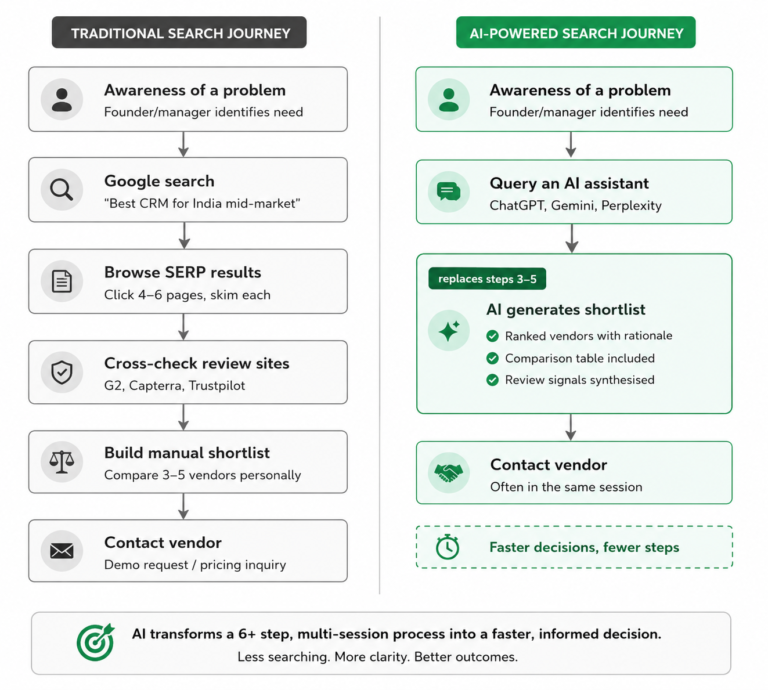
This is not theoretical. According to the Forrester B2B Buying Study, 2024, AI-powered search and answer experiences will drive more than half of B2B traffic by 2027, as AI agents sit inside CRMs, marketplaces, and internal communication tools, acting as the first point of discovery.
What's especially interesting for India is that our buyers are already comfortable with chat-based, text-first purchasing journeys - from WhatsApp-led B2B onboarding to conversational commerce. It's a small leap to imagine AI assistants becoming the default search bar for B2B discovery.
The 50% Prediction: How I Arrived at the Number
When I first landed on the 50% figure, I wasn't pulling a random big number out of thin air. I built it on a simple, three-layer framework that I still use with my own team at Redefine ROI.
Layer 1 - A Starting Baseline
Based on direct conversations with 15+ Indian B2B founders and marketing leads between 2025 and early 2026, I estimate that roughly 10–15% of B2B discovery journeys in India today already involve an AI assistant in some meaningful way - whether that's a prospect using ChatGPT to build a vendor shortlist, or a founder using Gemini to compare tools before a first call. This is not a published figure. It is a directional estimate from primary fieldwork, and I'm comfortable standing behind it.
Layer 2 - Macro-Level Analogies
That baseline sits alongside a broader set of forecasts: analysts consistently project that by 2027, AI will augment or automate roughly half of business decisions globally (Gartner, Future of Work Report, 2024). B2B buyers already spend 27% of their research time interacting with AI tools before a vendor conversation (Gartner B2B Buyer Research, 2023) - meaning more than 1 in 4 minutes of a buyer's research window is now spent with an AI assistant, not on your website. If AI can handle that share of decision-making, the same logic extends naturally to the discovery phase.
Layer 3 - Simple Growth Math and Field Data
If AI-influenced B2B search starts at around 10–15% today and grows at a pace similar to overall AI adoption in marketing and enterprise workflows - which are already showing double-digit YOY growth in India - it is reasonable to project that this share could roughly triple by 2027, landing in the 40–50% range. In that context, 50% becomes a conservative, directional ceiling: it's not a precise prediction, it's a call to action.
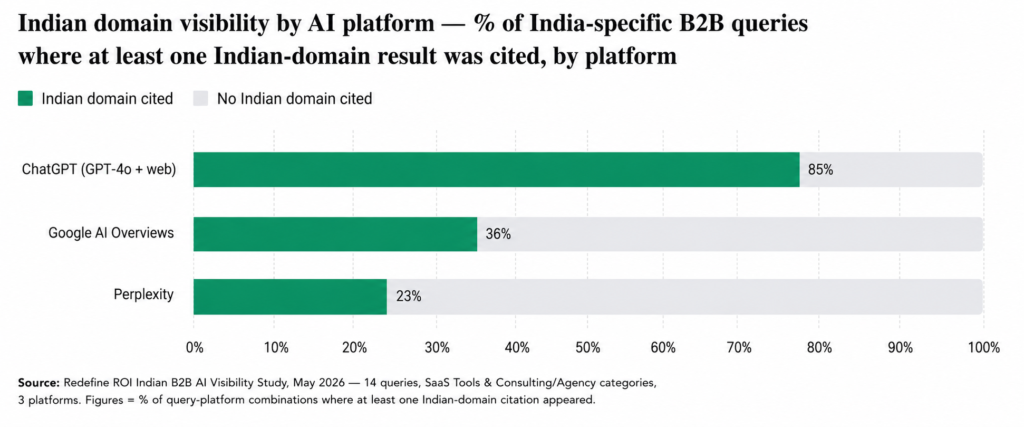
Our own research supports this range. In May 2026, the Redefine ROI research team tested 14 India-specific B2B queries across ChatGPT, Perplexity, and Google AI Overviews, covering SaaS tools and consulting/agency services. Here is what we found:
• ChatGPT cited an Indian domain in 85% of queries
• Google AIO did so in 36% of the same queries
• Perplexity returned zero visible source citations for 10 of 13 queries - it gave answers, but did not show where those answers came from
Indian vendors appeared in AI answers for only 47% of India-specific B2B queries tested - and of the 63 individual domain citations recorded across all platforms, 68% went to Indian-origin sources.
But that figure is heavily skewed by GST and compliance-specific queries where Indian tools dominate by default. For category-generic queries - best CRM, project management software, marketing automation - global domains dominated regardless of the India modifier in the question.
The visibility gap is not uniform. It depends entirely on which AI engine your buyer uses and the signals your content sends. Because of this, I'm comfortable standing by the statement that by 2027, AI-driven search and answer experiences will influence at least half of Indian B2B discovery journeys.
Original Analysis: The Indian B2B AI Search Gap
This section represents original analysis by Redefine ROI, based on internal query testing and client campaign data - not sourced from third-party reports.
Most AI search forecasts are built on US and European data. India's situation is structurally different in two ways that most analysts miss.
Finding 1 - Platform Behaviour Varies More than Brands Expect
In our May 2026 query testing, ChatGPT (with web search enabled) cited at least one Indian-domain source in 85% of India-specific B2B queries. Google AI Overviews did so in 36% of the same queries. Perplexity returned zero visible source URLs for 77% of India-focused B2B queries in our test set. It gave answers but didn't show where they came from.
Being visible on one AI platform does not mean you're visible on all of them. Indian brands need a multi-platform presence strategy, not a single-engine fix.
Finding 2 - The Compliance Trigger Effect
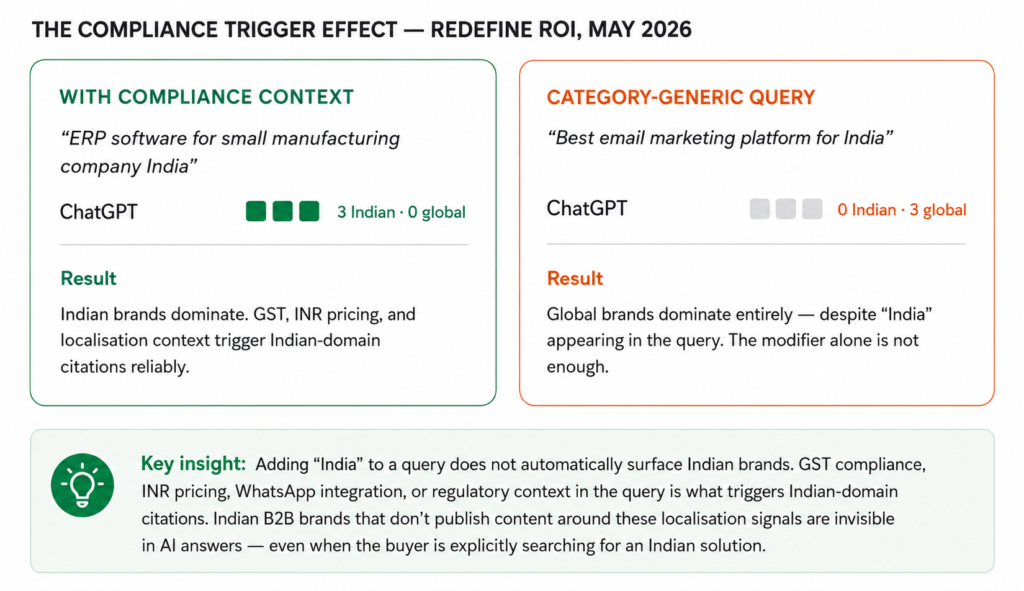
AI platforms are significantly more likely to cite Indian-domain sources when a query contains GST compliance, INR pricing, WhatsApp integration, or an India-specific regulatory context. In our test, the query ERP software for a small manufacturing company in India returned 3 Indian-domain citations and 0 global citations on ChatGPT. The query best email marketing platform for India returned 0 Indian-domain citations on the same platform.
The India modifier in a query does not automatically surface Indian brands. The compliance or localisation context does. Indian B2B brands that don't explicitly publish content around GST compatibility, INR pricing, or WhatsApp-led workflows are missing the exact trigger that gets them cited - even when the buyer is searching for an Indian solution.
Finding 3 - Cross-platform Consistency is Nearly Non-Existent
Of the 14 queries we tested, only one - video conferencing tools used by Indian enterprises - returned an Indian-domain citation consistently across all three platforms. For 9 of 14 queries, there was zero agreement between ChatGPT, Perplexity, and Google AIO on which Indian brands to surface. A brand that appears in a ChatGPT answer for a B2B query has, in most cases, no presence in Perplexity or Google AIO for the same query.
This is the multi-platform visibility gap. Each platform weights different signals - citation footprints, entity recognition, schema markup, third-party mentions - differently. Indian B2B brands cannot assume that ranking well on one AI engine transfers to another.
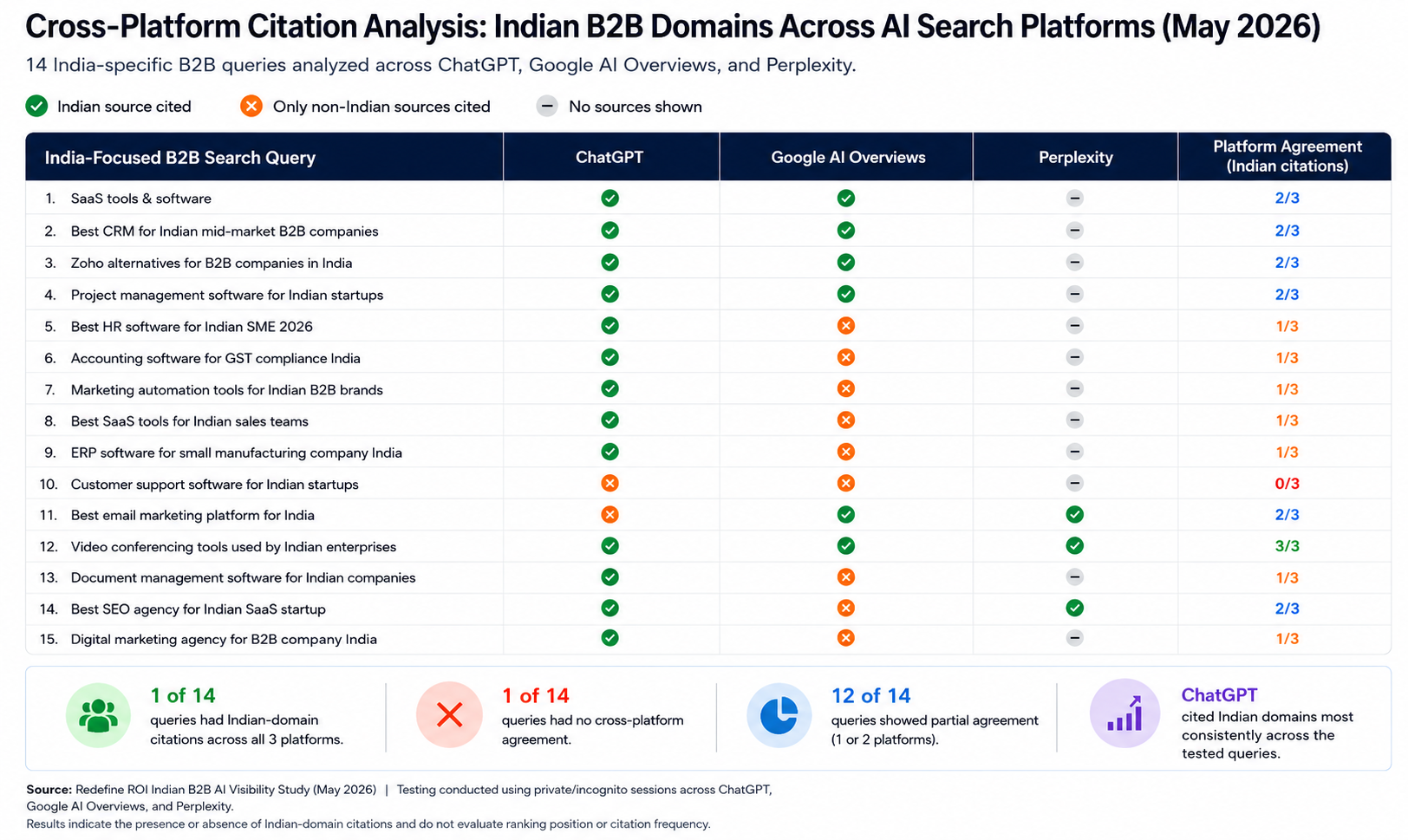
Scope Note: This analysis covers 14 queries across two categories - SaaS tools and consulting/agency services - tested on a single day in May 2026. Platform citation behaviour changes frequently. These findings are directional, not a statistically definitive benchmark.
What this Means for Indian B2B Brands
If part of your B2B search is already AI-driven, and that share is growing toward 50% by 2027, then your marketing, SEO, and brand-building strategies must evolve. Here are the moves I'm advising my clients at Redefine ROI to start making today.
1. Map Your Buyers' AI-Influenced Journeys
The first step is to actually understand how your buyers are using AI. Ask your sales team:
• How often do prospects mention using ChatGPT or Gemini before our first call?
•Have any prospects arrived with an AI-generated comparison sheet?Then track those leads in your CRM.
This is not a one-off; it's a new KPI: AI-influenced lead share. Over time, you will see how fast it's growing.
2. Build entity-rich, answer-friendly content
AI engines don't just read text; they interpret entities, relationships, and intents. That means:
• Creating clear, structured pillar content that defines your brand, product, and use cases in a way that's easy for AI to extract. Our guide on generative engine optimization explains the entity-first content model in detail.
• Using FAQs, comparison-style content, and clear pros-and-cons framing that mimics how buyers ask questions.
• Adding schema.org markup - Organization, Person, Product, FAQ - so that both traditional search and AI systems can connect your brand to relevant queries. See our complete GEO guide for 2026 for step-by-step implementation.
3. Optimise Website for AI Overviews and LLMs
Many Indian B2B buyers are already living inside their own ecosystems - CRMs, review platforms, marketplaces, and internal knowledge bases. Some of these are starting to embed AI-powered search and answer features. If you're relying only on Google, you are missing the fact that AI is already reshaping discovery.
• AI-driven search inside B2B ecommerce and SaaS directory platforms.
• AI assistants inside internal tools that surface vendor recommendations based on historical data.
The fix is not to pick one platform - it's to publish content structured so every platform can recognise and cite you. Our AI SEO optimization services are built specifically around this multi-platform visibility model.
Why I'm betting Redefine ROI on this shift
When I founded Redefine ROI, I wanted to build an agency that didn't just chase the latest SEO tactics, but helped brands anticipate and adapt to the next big wave. Ten years ago, that wave was mobile and intent-based search. Five years ago, it was voice and local-first. Today, in India, it's AI-driven B2B discovery.
From my own experience:
• I've seen how quickly Indian founders adopt tools that shave time off research and sales cycles.
• I've watched markets that were once sceptical of AI suddenly normalize it as a default assistant in their workflows.
• I've worked with brands that built their visibility around Google, only to see that visibility fragmented across multiple channels - and now, AI answers.
That's why I'm not just predicting a 50% shift to AI-driven B2B search by 2027; I'm structuring Redefine ROI around it. We're building:
• Diagnostic frameworks to measure a brand's AI search readiness. Understand how GEO differs from AI SEO and which approach fits your stage.
• Playbooks to optimize for AI-influenced journeys, not just traditional SERPs, grounded in our GEO and LLM optimization methodology.
• Small-scale experiments that help Indian B2B brands stay one step ahead of the curve.
The Future of B2B Search is a Conversation, Not Ranking on SERPs
If AI will sit next to every Indian decision-maker by 2027, then B2B brands have to stop thinking only in terms of How do I rank? and start asking: How do I optimise my brand for AI engines, so my products get cited by LLMs when a buyer is searching for what I offer? That's where the real competitive moat will be built.
At Redefine ROI, my mission is to help Indian B2B brands navigate this shift - not as a passive trend, but as an active opportunity. The 50% prediction is a signal, not a final number. If you're an Indian B2B marketer, founder, or agency leader who wants to test your own AI search readiness, start with a free AI visibility audit.
