
1. GEO is about being chosen by AI answer engines, not ranked by search engines.
2. LLMs retrieve chunks, not pages – write every paragraph as a standalone answer.
3. The top 3 highest-leverage GEO tactics are: answer-first content architecture, FAQ schema markup, and comprehensive entity coverage.
4. Entity coverage, factual density, and self-citation beat keyword stuffing.
5. Different AI platforms use different retrieval mechanisms – Google AIO, Perplexity, and ChatGPT each require tailored optimization approaches.
6. GEO compounds over time – brands building topical authority clusters and citation-friendly content now will have durable advantages as AI search continues growing.
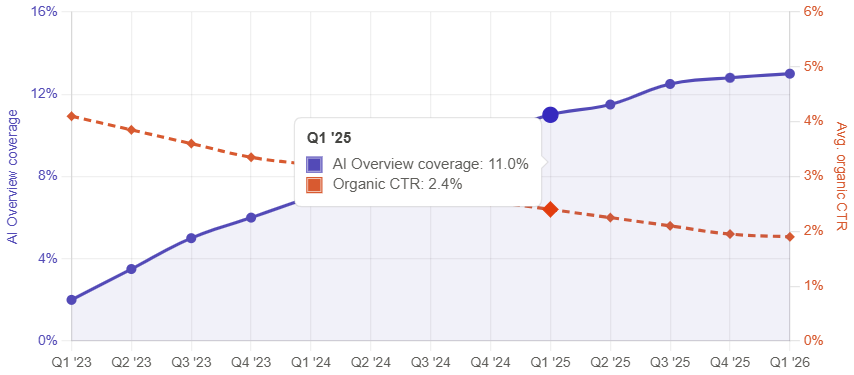
What’s Changed? In 2026, Google AI Overviews now cover 13%+ of all searches. Perplexity passed 100M monthly users. Reasoning models like OpenAI o3 and Gemini 2.5 Pro don’t just retrieve content – they evaluate its logical soundness and credibility before citing it. Having a GEO strategy that dates back to 2023 is already outdated.
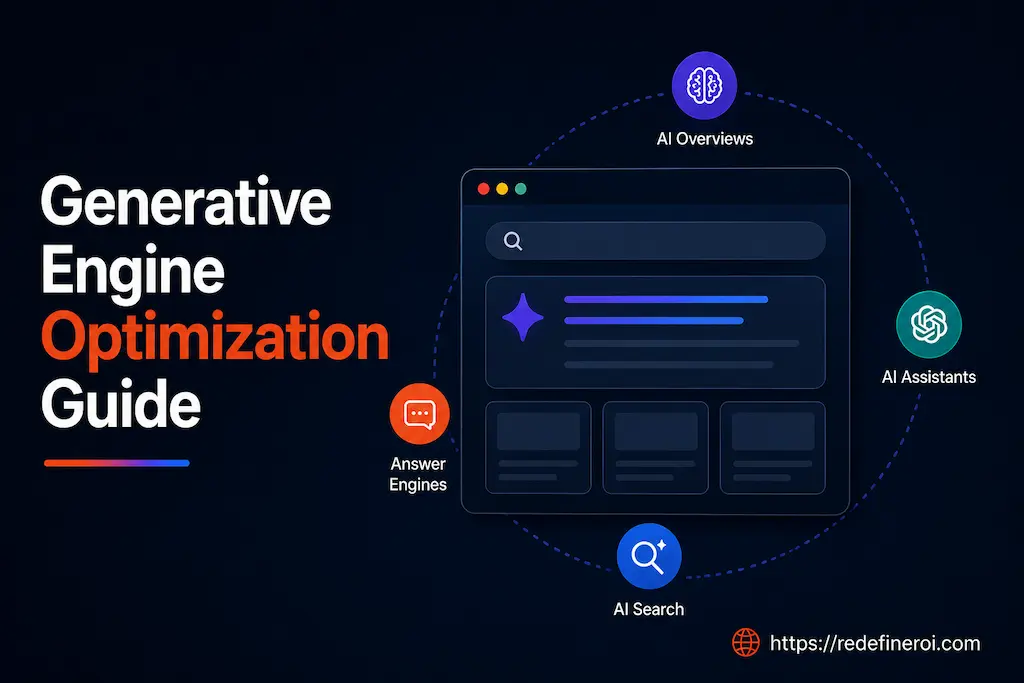
This GEO Optimization Guide 2026 covers:
- What is Generative Engine Optimization (GEO)? – A clear definition of GEO and how it differs from traditional SEO.
- Why does GEO matter in 2026? – Data on AI search growth and what it means for content visibility.
- How do LLMs retrieve and cite content? – The actual technical process behind AI answer generation.
- GEO vs. Traditional SEO – A side-by-side comparison of goals, tactics, and success metrics.
- Step-by-step GEO strategy – A practical, platform-aware optimization framework you can apply today.
In 2026, Search discoverability is not about keyword rankings. It’s about being chosen by LLMs.
With platforms like ChatGPT, Google AI Overviews, and Perplexity AI now delivering direct answers, the question isn’t “where do I rank?” It’s “Does AI include my content in its answer?”
That question is the foundation of GEO optimization – one of the most significant shifts in search since the introduction of PageRank.
What Is Generative Engine Optimization (GEO)?
Generative Engine Optimization (GEO) is the process of structuring and writing content so that generative AI systems – including ChatGPT, Google AI Overviews, Perplexity, Gemini, and Microsoft Copilot -retrieve, understand, and cite it as a source in their AI-generated answers.
Unlike traditional SEO services, which prioritize ranking for keywords in SERPs like Google and Bing, GEO optimizes for inclusion in the answer itself. When a user asks Perplexity, “What is the best CRM for small teams?” GEO determines whether your brand shows up in the cited sources – or doesn’t.
In practice, GEO involves:
- Write content that provides AI systems with a clean, extractable answer
- Building entity coverage around your topic so AI models recognize your content as topically authoritative
- Using structured formatting (headings, tables, definitions) that language models parse easily
- Establishing E-E-A-T signals (Experience, Expertise, Authority, Trust) for AI systems
- Citation-friendly formats, definitions, comparisons, statistics, and how-to steps – that AI responses commonly use
In the SEO era, the goal was to rank. In the GEO era, the goal is to be chosen. Those are not the same game.
Why GEO Matters in 2026
The search discovery in 2026 looks fundamentally different from what it did even two years ago. Three forces converged:
- Google AI Mode rolled out broadly in 2025, reshaping how Google surfaces results for conversational queries.
- ChatGPT Search (launched in 2024) and Perplexity crossed meaningful user adoption, with Perplexity reporting over 20 million monthly active users by mid-2025.
- Zero-click search continued its climb – SparkToro’s 2024 analysis found 60% of Google searches ended without a click, and that share has grown since.
This creates a two-tier content ecosystem:
1. Content that gets cited – visible, authoritative, and traffic-generating through AI referrals.
2. Content that doesn’t – effectively invisible to a growing portion of searchers, regardless of its keyword ranking.
The practical result: fewer users visit websites to get answers. They read the AI-generated response and leave. If your content isn’t inside that response, you’re invisible – regardless of where you rank organically.
What’s Changed in 2026
| What’s Shift | 2023 | 2026 |
|---|---|---|
| Primary visibility surface | Top 10 Blue Links in SERPs | AI-generated answer box |
| User click behavior | Click → read → leave | Read summary → may not click |
| Source attribution | Good Quality Backlinks | In-answer citations |
| Key ranking signal | Authority + keywords | Entity clarity + factual density |
| Measurement tool | Google Search Console & Analytics, SEMRush, Ahrefs | Manual + Profound, Peec AI, AthenaHQ |
| Content refresh | 6–12 months | 2–4 months (LLM index decay) |
How LLMs Actually Retrieve and Cite Content
Here’s what actually happens when you ask Perplexity or ChatGPT a question:
Step 1: Query Interpretation
The LLM rewrites your natural-language question into one or more retrieval queries – often several simultaneously, covering different intents.
Step 2: Retrieval (The Critical Step)
Retrieval-augmented generation (RAG) is used by generative engines. Rather than scanning the whole content, LLMs extract chunks (usually 200–500 characters) from a paragraph. Your paragraph, not your page, is what competes.
Step 3: Relevance Scoring
Each content chunk is scored on semantic match, source authority, recency, and factual density.
Step 4: Answer Synthesis
The model composes an answer by weaving together the top-scoring chunks, typically citing 3–7 sources.
Step 5: Citation Selection
The final citations shown to the user are the sources whose chunks contributed most, and whose authority the model can verify.
Optimizing for ChatGPT, Perplexity, and Google AI Overviews requires meaningfully different approaches because each uses a different retrieval architecture.
| Platform | Retrieval Type | Primary Optimization Lever | Freshness Sensitivity | Schema Impact |
|---|---|---|---|---|
| Google AI Overviews | Real-time + indexed | Traditional SEO + E-E-A-T + schema | High | Very high |
| Perplexity AI | RAG (live crawl) | Crawlability + semantic clarity + citations | Very high | Moderate |
| ChatGPT (browsing) | RAG (Bing index) | Bing indexation + answer-first structure | High | Moderate |
| ChatGPT (no browsing) | Pre-trained knowledge | Training data presence + domain authority | Low | Low |
| Bing Copilot | RAG (Bing index) | Bing SEO + structured content | High | High |
A 2,000 + word content isn’t retrieved as a whole. Only the passages that read like complete, citable answers get pulled. Write every paragraph as if it could stand alone.
“According to a research from SE Ranking (2025) found that pages already ranking in the top 5 organic results for a query appear in Google AI Overviews for that same query approximately 74% of the time.”
GEO vs. Traditional SEO: Key Differences
| Factor | Traditional SEO | Generative Engine Optimization (GEO) |
|---|---|---|
| Primary goal | Rank higher in results | Be cited in AI-generated answers |
| Success metric | Organic traffic, SERP position | AI citations, brand mentions in AI responses |
| Content focus | Keyword optimization | Context, entities, semantic completeness |
| Link signals | Backlinks critical | Domain authority as trust proxy, less direct |
| Format preference | Long-form, keyword-dense | Structured, answer-first, definition-rich |
| Freshness impact | Moderate | High (especially for RAG-based systems) |
| Platform-specific tuning | Primarily Google | Google AIO, Perplexity, ChatGPT, Bing Copilot |
| Schema markup | Helpful for rich snippets | Increasingly critical for AI inclusion |
| Measurement tools | GSC, Ahrefs, Semrush | SE Ranking AI, Perplexity tracking, manual audits |
| Result timeline | Weeks to months | Weeks to months (similar, but different signals) |
GEO doesn’t replace SEO; it complements it. A well-optimized page that ranks well also tends to perform better in AI citations – particularly on Google. The difference is that GEO adds a layer of citation-readiness that pure SEO ranking doesn’t require.
How to Strategise Your GEO Strategy in 2026
Here’s how to act on it:
Find your bleeding queries first
- Open Google Search Console → Performance → Queries.
- Filter for the top 5 pages where impressions have remained steady, but clicks have declined over the last 12 months.
- A stable rank with falling CTR almost always means an AI Overview is taking away those clicks above you.
This is the highest priority GEO target – the authority signal is already there, but you need to become cited inside the answer box.
Segment by query type, not volume.
The 13% coverage figure is an average:
- Informational queries (“what is X”, “how does X work”) see AI Overviews on 35–50%+ of searches.
- Comparison and how-to content sits at 20–40%.
- Transactional and local queries are under 10%.
Invest in informational and comparison content first – that’s where traffic is bleeding fastest.
Sort your content into three buckets:
- The top 5 ranking pages with declining CTR should be optimized now- update timestamps, answer-first structure, and FAQ schema for GEO. Best ROI, fastest wins.
- Create new, high-volume informational queries where you have no content and an AI Overview already exists. No content means zero citation chance.
- Leave alone – transactional and commercial pages. AI Overviews rarely appear here; focus on conversion optimisation instead.
Track the trajectory, not just the number. 13% today, but coverage is still accelerating – analysts project 25–30% for informational queries within 18 months. Content you optimise now compounds in value as the AI Overview footprint expands.
The Core Elements of GEO Optimization
1. Answer-First Content Architecture
AI systems don’t read your introduction. They scan for the most direct, structured answer to the query, and if your content buries it under three paragraphs of context, it gets passed over in favor of something cleaner.
Answer-first structure means:
- Open every section with the direct answer.
- Define your primary topic within the first 100 words of each section.
- Use question-format H2/H3 headings that mirror how users phrase queries (e.g., “What is GEO?” rather than “Introduction to GEO”)
2. Entity Coverage and Semantic Depth
Modern LLMs don’t evaluate content based on keyword frequency. They evaluate it based on topical coverage – how comprehensively a piece covers the full semantic territory of a subject.
For content about GEO, strong entity coverage means the content explicitly addresses and connects:
- Core entities: Generative Engine Optimization, Large Language Models, RAG, AI Overviews, Perplexity AI, ChatGPT, Bing Copilot
- Related concepts: E-E-A-T, schema markup, zero-click search, answer engines, topical authority
- Contextual relationships: Why GEO differs from SEO, how RAG retrieval works, what signals AI uses for source selection
3. Structured Formatting for Extraction
AI systems parse structured content more reliably than dense prose. Practical formatting rules for GEO:
- Use H2/H3 hierarchies that create a clear logical outline (LLMs use headings to understand document structure)
- Keep paragraphs to 3–4 lines maximum – long paragraphs reduce extraction accuracy.
- Use comparison tables for any “X vs. Y” or “options” content (AI models pull tables frequently)
- Use numbered lists for processes and steps; bulleted lists for features or attributes.
- Add FAQ sections with explicit question/answer pairs – these are among the highest-cited content formats in AI responses.
4. Definition Paragraphs
LLMs frequently cite clean, authoritative definitions because they’re compact, quotable, and factually dense. Every major concept in your content should have one.
A strong definition paragraph:
- States the term clearly in the first sentence
- Explains what it does, not just what it is
- Positions it within a broader context (the “what makes this significant” sentence)
- Is 2–4 sentences long – dense enough to be informative, short enough to quote directly
Example of a strong definition paragraph (see “What is Generative Engine Optimization?” above) vs. a weak one (“GEO is basically like SEO but for AI.”).
5. E-E-A-T Signals
Google’s E-E-A-T framework is not a Google algorithm, but it is very important for assessing content quality. In 2026, AI systems, particularly Google’s AI Overviews, use E-E-A-T signals as proxies for credibility when deciding which sources to cite.
Actionable E-E-A-T improvements for GEO:
- Author bylines with credentials – a named author with a demonstrable background in the topic signals expertise
- Cite external authoritative sources – linking out to peer-reviewed research, government data, or recognized industry reports signals that your content isn’t operating in an information vacuum
- About pages and author pages – AI systems follow entity links; a well-developed author page creates a stronger knowledge graph connection between your content and the real person/organization behind it
- Last-updated timestamps – freshness is a credibility signal, particularly for rapidly evolving topics like AI search
6. Schema Markup
FAQ Schema allows search engines to parse your FAQ section as structured question/answer pairs – exactly the format AI Overviews pull from most aggressively.
Additional schema types relevant to GEO:
- Article schema with datePublished and dateModified – signals freshness
- HowTo schema for step-based content
- Person schema on author pages – strengthens entity disambiguation
- Organization schema – builds knowledge graph presence for brand entities
7. Add an llms.txt File (Emerging Standard)
Proposed in late 2024 and gaining traction in 2025–2026, llms.txt is a plain-text file at your domain root that gives LLMs a curated, markdown-formatted map of your most important content.
The Citation Decay Problem
When you publish a piece of content, it’s not immediately retrievable by every generative engine. Each system maintains its own index with its own refresh cadence:
- Perplexity retrieved in near real-time via live search
- ChatGPT Search indexes within days to weeks
- Google AI Overviews tracks the main Google index (hours to days)
- Gemini blends real-time search with its training cutoff
- Base-model ChatGPT (without browsing) relies on its training cutoff – meaning content can be invisible for months
Perplexity might cite your content on day one or two, and still be invisible to base ChatGPT a year later. Tracking a single “GEO score” is a mistake.
The practical approach: treat GEO measurement as a portfolio rather than a single metric. Track citation share across each engine independently.
How to Measure Your Website GEO Performance
Here are some of the tools that you can actually use to measure the success of your website and GEO performance.
| Platform | Retrieval Type | Primary Optimization Lever | Freshness Sensitivity | Schema Impact |
|---|---|---|---|---|
| Google AI Overviews | Real-time + indexed | Traditional SEO + E-E-A-T + schema | High | Very high |
| Perplexity AI | RAG (live crawl) | Crawlability + semantic clarity + citations | Very high | Moderate |
| ChatGPT (browsing) | RAG (Bing index) | Bing indexation + answer-first structure | High | Moderate |
| ChatGPT (no browsing) | Pre-trained knowledge | Training data presence + domain authority | Low | Low |
| Bing Copilot | RAG (Bing index) | Bing SEO + structured content | High | High |
“Manual prompt-testing still matters. Build a tracker with 30–50 target prompts your buyers would realistically ask, and check monthly whether your brand appears in the cited sources.”
Common GEO Mistakes to Avoid
- Treating GEO as a single-platform discipline: Perplexity rewards recency; base ChatGPT rewards authority in its training data.
- Writing for keywords, not for questions: LLMs don’t count keyword frequency; they map concepts.
- Ignoring schema markup: FAQ, HowTo, and Article schema remain strong signals for AI Overviews.
- Creating thin, summary-level content: AI systems select sources that are deep and comprehensive.
- Not measuring AI visibility at all: manual audit of 10 target queries across Perplexity and Google AIO is vastly better than no measurement at all
- Assuming GEO replaces SEO: LLMs often name brands without linking to them; traditional analytics miss this entirely.
The Contrarian View: When GEO Doesn’t Work
Not every business benefits equally. GEO underperforms for:
- Pure transactional queries where users still want to click (checkout flows, software downloads)
- Highly local businesses where Google Maps still dominates
- Brand-defensive searches where your own domain already wins
- Regulated industries (finance, medical), where LLMs often decline to cite individual sources
If 80% of your conversions come from bottom-funnel keywords with clear buyer intent, classical SEO still outperforms GEO.
GEO wins for top-of-funnel discovery and category education, while SEO wins for high-intent conversions. Run both funnel stages, weighted by stage.
Bottom Line: Our Verdict
In 2026, whether it’s SEO agencies or brand owners that take AI SEO optimization seriously will build a compounding asset. Once an AI system recognizes your domain as an authoritative source, that trust tends to persist.
As AI dominates the landscape in 2027, brands that wait for GEO to “mature before investing” will need to rebuild from scratch.
That said, GEO is not a replacement for solid content strategy, domain authority building, or traditional SEO. It’s an additional layer – one that amplifies the value of good content for a new and rapidly growing distribution channel.
In 2026, visibility isn’t about ranking. It’s about being chosen.
Important FAQs
GEO is the practice of structuring content so that AI tools like ChatGPT, Perplexity, Gemini, and Google AI Overviews cite it as a source when generating answers for users. Where SEO earns a ranking, GEO earns a citation inside the AI’s response.
In search engine results pages, SEO optimizes content to rank for links. In AI-generated answers, GEO optimizes content for inclusion. Unlike SEO, GEO rewards entity coverage, factual density, self-citation, and chunk-level readability. Strong SEO content can also be decent GEO content, but GEO requires specific considerations.
Make sure that direct answers are written early in each section, that you cite your own authority sources, that you add named statistics and dated studies, that you publish original data, and that you maintain a 60–90 day refresh cycle.
No. GEO complements SEO. While traditional SEO remains preferred for high-intent, transactional queries, top-of-funnel discovery, and category-education queries are increasingly handled by AI engines. There should be a mix of both, weighted by funnel stage for most teams.
llms.txt is an emerging standard (proposed in late 2024) in which site owners place a Markdown-formatted file at the root of their domain to provide LLMs with a curated map of their most important content. It’s the generative-era cousin of robots.txt. Adoption is still early, but major publishers, including Anthropic and Cloudflare, have implemented it.