


Published Date: 26-04-2026, Last Update: 26-04-2026 By [Mrinal Kaushik]
How to Optimize Content for ChatGPT, Gemini, and Perplexity?
AI search engines generate answers; they don’t just rank pages like Google. To optimize content for AI search engines:
- – Start each heading section with a direct answer in the first 1–2 sentences.
- – Include named statistics and add sources – Answer-first writing increases AI citation chance by 40%
- – Use the FAQ Schema directly, as it improves visibility in Google AI Overviews
- – llms.txt is an emerging file standard that helps AI crawlers find your best content
- – Update your content at least every 90 days.
This guide includes key concepts and practical tactics that are making a difference in 2026.
- What AI search engines are and why they select content differently from Google
- The GEO framework (Generative Engine Optimization) – what it means and how it differs from traditional SEO
- Platform-specific strategies for ChatGPT, Gemini, and Perplexity AI
- Structural, semantic, and authority signals that increase your chances of being cited
- How to audit and measure your AI citation visibility – a step most guides skip entirely
What’s Changed in 2026: AI Search Is No Longer Optional
Two years ago, AI search optimization was a forward-looking discipline. Today, it’s a present-day business requirement.
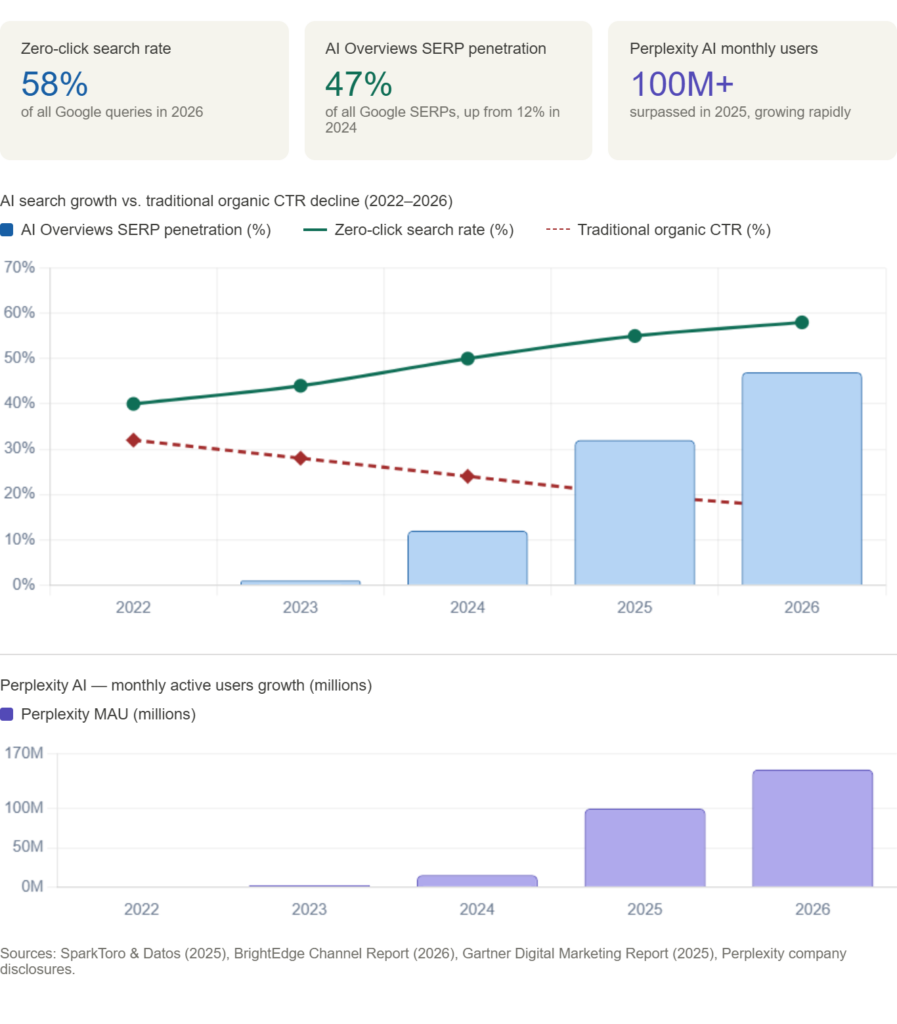
“A 2025 study by SparkToro & Datos found that zero-click searches make up over 58% of all Google queries”.
“Gartner’s 2025 Digital Marketing Report says traditional search engine volume will fall by 25%. This drop is expected by 2026.”
The shift isn’t coming; it’s here.
Three things changed the game specifically in 2026-2027:
- ChatGPT launched persistent web browsing with real-time citations, meaning your live content is now actively retrieved and quoted.
- Perplexity has over 100 million monthly active users. It is now a key research tool for professionals.
- Google’s AI Overviews became the default on desktop globally, fundamentally changing what “ranking” means.
If your content strategy relies only on 10 blue links, you’re missing the search experience most users want.
What Are AI Search Engines?
AI search engines, also known as AI answer engines or generative search engines, use large language models (LLMs). They take a user’s query and find relevant content from the web or a knowledge base. Instead of giving a ranked list of links, they provide a direct, synthesized answer.
AI answer engines differ from traditional search engines. Instead of just ranking pages, they read, assess, summarize, and cite chosen sources. The output feels like a chat. It includes references instead of a results page that users have to click through.
Key Platforms :
- ChatGPT (OpenAI) – with real-time web browsing via SearchGPT
- Gemini (Google DeepMind) – powers AI overviews in Google Search
- Perplexity AI – dedicated answer engine with real-time web citations
- Microsoft Copilot – integrated into Bing and Microsoft 365
- Claude (Anthropic) – increasingly used for research via web search
The question is no longer ‘how do I rank on page one?’ — it’s ‘how do I become the source an AI trusts enough to quote?
What Is Generative Engine Optimization (GEO)?
GEO LLM Optimization is the process of structuring and writing content so that generative AI systems – including ChatGPT, Google AI Overviews, Perplexity, Gemini, and Microsoft Copilot -retrieve, understand, and cite it as a source in their AI-generated answers.
It differs from traditional SEO in that it targets the retrieval and synthesis layer of AI systems, rather than just the indexing and ranking layer of search engines.
GEO operates on three principles:
- Retrievability – Can the AI find and access your content?
- Parsability – Can the AI extract clean, accurate information from it?
- Citability – Does the AI trust your content enough to reference it by name?
How ChatGPT, Gemini & Perplexity Select and Cite Content
This is the section most guides skip. Each platform has a distinct retrieval and ranking logic.
| Factor | ChatGPTSearchGPT |
GeminiAI Overviews |
Perplexity AIAnswer Engine |
|---|---|---|---|
| Primary Retrieval | Real-time Bing-powered web search | Google Search index | Real-time web crawl (own index) |
| Citation Style | Inline footnotes | Expandable source cards | Numbered inline citations |
| Favors | High-authority domains, clear answers | Content ranking in Google top 10 | Structured, factual, recently updated content |
| Schema Sensitivity | Moderate | High — FAQ, HowTo, Speakable | Low – Moderate |
| Recency Weighting | High | Moderate | Very High |
| Best Content Format | Definitions + listicles + step-by-step | Long-form with headings & tables | Short, direct answers with cited data |
| Supports llms.txt | Likely (emerging) | No confirmation | Yes (partial) |
Perplexity heavily weights recency and citation density within the content itself. Gemini and AI Overviews lean on what already performs in traditional Google search. ChatGPT’s SearchGPT favors domain authority combined with answer-first structure.
Why AI Visibility Optimization Matters: The Business Case
Organic traffic is shifting, not disappearing. Only brands with AI-friendly content are catching this new trend.
According to a 2026 Semrush Trends report, answer engine-optimized websites received 32% more branded search traffic. When a brand is referenced in an AI answer, users can search for it directly.
For B2B brands, the impact is even sharper. Forrester’s 2025 Buyer’s Journey Study found that 67% of B2B buyers use AI tools for initial research. So, if AI isn’t citing you, you’re invisible at the top of the funnel.
Three real consequences of ignoring AI visibility:
- Your competitors get cited; you don’t – even if you outrank them on Google
- Brand awareness declines as AI becomes the first touchpoint for discovery
- Content ROI drops as click-through rates from traditional SERPs continue to erode
How to Optimize Content for AI Search Engines
1. Write Direct Answer-First, Then Elaborate
Artificial intelligence systems search for answers that are clear and direct. Content that buries its answer under 300 words of long phrases is rarely cited.
Structure every major section like this:
- Direct answer (1–2 sentences): Exactly what the query asks
- Explanation: Why it works, context, nuance
- Evidence: Data, examples, and expert references
- Expansion: Related subtopics, edge cases
2. Build Semantic Depth, Not Just Keyword Density
Traditional SEO optimization rewards keyword density. AI engines value semantic entities, meaning they assess how well your content covers the full scope of a topic.
To build semantic depth:
- Cover the topic’s definition, mechanism, benefits, limitations, and comparisons
- Use related entities (tools, people, organizations, events) throughout
- Include co-occurring concepts- terms that naturally appear alongside your primary keyword
If you are thinking of writing an article on “AI search optimization guide“, it should clearly mention:
- Large Language Models
- Retrieval-augmented generation (RAG)
- Entity recognition
- Structured data
- E-E-A-T
- Search Generative Experience (SGE)
Not as keywords – as actually explained concepts.
3. Use Structured Markup That AI Can Parse
Not all schemas are the same; they serve different roles depending on the page type.
Schema types with the highest GEO impact:
| Schema Type | Why It Matters for AI |
|---|---|
| FAQ Schema | Maps directly to PAA-style query answering; Gemini pulls FAQ blocks into AI Overviews |
| HowTo Schema | Step-by-step content is highly citable in instructional AI answers |
| Article Schema | Provides author, date, and publication signals LLMs use for credibility assessment |
| Speakable Schema | Designed for voice/audio AI; marks which sections are ideal for direct reading |
| Organization Schema | Establishes brand entity; helps LLMs associate content with a trusted source |
4. Establish Topical Authority Through Content Clusters
AI systems check not just pages but entire domains to assess their expertise on topics. A website that shares clear and accurate content helps AI systems view it as a trusted source.
How to Build Topical Authority for GEO:
- Create a pillar page that covers the core topic in detail
- Build cluster pages around subtopics, each linking back to the pillar
- Maintain publishing consistency – fresh content signals active expertise
- Update existing content rather than only publishing new articles – recency signals matter
A domain with 40 focused, well-kept articles on “AI search” will do better than one with 200 scattered articles on AI citation.
5. Optimize for Perplexity AI
Perplexity operates differently from Google-based AI systems. It runs its own crawl and puts a lot of weight on recency. It also clearly shows citations, so being cited here can be measured directly.
Perplexity-specific optimizations:
- Publish dates and update dates must be visible in HTML (not just CMS metadata)
- Include data with sources – Perplexity favors content that cites external research itself.
- Use numbered or bulleted lists for factual claims – these are extracted cleanly.
- Short, clear sentences in the opening paragraphs – Perplexity often cites the first main paragraph of a section.
- Avoid heavy JavaScript rendering – Perplexity’s crawler has limited JS execution capabilities.
6. Optimize for ChatGPT (SearchGPT)
ChatGPT relies on Bing’s index as its main source; it then applies its own filters for relevance and quality.
ChatGPT-specific optimizations:
- Ensure Bing Webmaster Tools indexing is active (separate from Google Search Console)
- Write content that directly answers users’ prompt queries – users generally ask long tail queries.
- Use clear attribution language. For example, say, “According to [study]” or “Research by [organization] shows…” This helps ChatGPT recognize and reward good sourcing
- Don’t place thin content at the top of pages; ChatGPT’s browsing focuses on the first 500–1000 words.
7. Put in place the llms.txt File
This is the emerging signal that almost no competitor covers.
llms.txt is a new open standard, like robots.txt. It helps website owners share a simple summary of their site’s content and structure for LLM crawlers.
By placing an llms.txt file at your domain root (e.g., yourdomain.com/llms.txt), you can:
- Signal which pages are your highest authority content
- Provide a plain text summary of your site’s expertise.
- Reduce noise for AI crawlers (helping them find your best content faster)
Perplexity isn’t used by all AI platforms yet, but it knows the standard. This makes it a simple choice with great potential for forward-thinking publishers.
8. Add FAQ Sections Structured for PAA and AI Extraction
FAQ sections serve two main purposes: they appear in Google’s “People Also Ask” boxes and provide clear, quotable Q&A for AI answer engines.
Best Practices for GEO-Optimized FAQs:
- Keep answers between 40-80 words – long enough to be substantive, short enough to quote
- Every answer should begin with a clear, direct statement that restates the question
- Use the FAQ schema markup on every FAQ section
- Place the FAQ section at the end of major H2 sections, not at the bottom of the article
- Include long-tail, conversational questions that mirror how users type into ChatGPT or Perplexity
9. Build E-E-A-T Signals AI Systems Can Parse
Google’s E-E-A-T (Experience, Expertise, Authoritativeness, Trustworthiness) framework impacts AI retrieval. Gemini and AI overviews closely align with Google’s quality signals.
Practical E-E-A-T Actions for GEO:
- Add a visible author byline with a link to a credentialed author bio
- Include first-person experience notes where relevant (“In auditing 50+ sites for AI visibility…”)
- Cite named, dated, specific sources – not generic “studies show” language
- Display the last updated dates prominently rather than solely in metadata.
- Earn or show third-party citations. When other trusted sites reference your content, AI systems notice this.
The GEO Citation Score Framework
The actual optimization of content will be done only when you monitor and measure its readiness. Here’s a practical scoring framework for evaluating any piece of content’s AI citation readiness:
The GEO Citation Readiness Score (CRS)
Score each article out of 100 across five dimensions:
| Dimension | Max points | What to check |
|---|---|---|
| Answer Density | 25 | Does every H2 section open with a direct 1–2 sentence answer? |
| Entity Richness | 20 | Are named entities (tools, studies, people, stats) present throughout? |
| Structural Clarity | 20 | Are headings, tables, and lists used logically and consistently? |
| Source Authority | 20 | Are at least 3 external, named, dated sources cited? |
| Freshness | 15 | Was the content published or updated within 6 months? |
Interpretation:
- 85–100: High GEO readiness – strong candidate for AI citation
- 65–84: Moderate – likely cited for some queries, not others
- Below 65: Low readiness – structural and content improvements needed
Run this against your top 10 traffic pages before your competitors do.
How to Measure AI Citation Visibility
After you optimize your content, wait 2-3 days. Check whether LLMs are citing it or if it is functioning effectively.
Practical methods to track AI citation:
Third-party tools: Tools like Semrush’s AI Toolkit, BrightEdge’s AI Overviews tracker, and Authoritas offer AI visibility monitoring dashboards
Manual query testing: Manually check your target keywords in ChatGPT, Perplexity, and Gemini. Screenshot and log whether your domain appears in citations
Perplexity source tracking: Perplexity explicitly shows its sources. Use the Perplexity API or manual querying to check citation frequency
Branded search monitoring: Use Google Search Console to track branded search volume increases. AI citations often drive users to search your brand name directly
The Role of AI SEO Services for Brands
Brands without in-house GEO experts now have a new option: AI-driven SEO services.
The best AI SEO services for brands in 2026 go beyond content rewrites. They provide:
- GEO audits – evaluating existing content against AI citation readiness
- Structured data implementation – particularly FAQ, HowTo, and Speakable Schema
- Content architecture redesign – restructuring site hierarchy for topical authority
- AI citation monitoring – tracking brand visibility across ChatGPT, Gemini, and Perplexity
- Entity building – establishing your brand as a named entity that LLMs consistently recognize
When you are looking for GEO and LLM optimization services provider, ask: “Can you show examples of content you’ve optimized that AI answer engines now cite?”
Traditional SEO marketing agencies that added “AI” to their services aren’t the same as those with real GEO experience.
Key Takeaways
- GEO (Generative Engine Optimization) is the process of optimizing content so it’s cited by LLMs and differs from traditional SEO.
- Each AI platform (ChatGPT, Gemini, Perplexity) has different retrieval logic – one-size-fits-all optimization misses the point.
- Three key content changes can make a big impact: use an answer-first structure, add semantic depth, and include cited data.
- llms.txt is a new standard. It’s smart to adopt it now, before it becomes essential.
- Measuring AI citation requires active monitoring – not simply publishing content and hoping.
- AI cites sources more often. It is a key GEO insight that is often overlooked.
- Domain-level topical authority matters more than individual page authority for AI retrieval.
Summary: The Shift to Generative Engine Optimization (GEO)
By 2026, AI search is a business mandate. Traditional search volume is expected to fall by 25%. Zero-click queries now make up over 58%. So, visibility relies on Generative Engine Optimization (GEO).
GEO differs from traditional SEO. It aims to make content easy to find, read, and cite for LLMs like ChatGPT, Gemini, and Perplexity. The success of a campaign requires moving beyond “ranking” to becoming a trusted, cited source through direct, answer-first structures and deep semantic authority.
Immediate Next Steps:
- Audit Top Pages
- Implement “Answer-First” Structure and Schema
- Add the llms.txt file to your root domain
- Manually test target queries across AI platforms.

Mrinal Kaushik
Mrinal Kaushik is the Founder of Redefine ROI, where he helps startups, eCommerce, healthcare, and B2B brands adapt to the changing world of search. With 13+ years of SEO experience and 100+ SEO audits and campaigns across WordPress and Shopify, he works with businesses to improve their visibility not just on Google, but across AI-powered search experiences like ChatGPT, Google AI Overviews, and Perplexity. Outside of client work, he enjoys exploring how AI is changing search and sharing practical insights that help businesses stay ahead of what's next.


[…] systems prioritize authoritative sources. Content optimized to be cited by AI engines presents proprietary data, original research, or expert analysis than content that summarizes […]