

What is AI SEO and why does it matter?
AI SEO is how you optimize content so AI search engines like ChatGPT, Gemini, and Perplexity can find, understand, and actually cite it in their answers.
- AI search engines now deliver direct answers — they don’t just hand you a list of links anymore.
- Google AI Overviews picks content that’s clear, well-structured, and easy to summarize.
- Entity relationships and topic context carry more weight than keyword stuffing.
- You build topical authority through connected content clusters, not one-off blog posts.
- Short paragraphs, descriptive headings, and bullet points make your content easier for AI to extract.
- Traditional SEO still matters, but it won’t get you into AI-generated results on its own.
- Content that’s thorough and kept up to date stands a much better chance of being cited by Google AI Overviews.
Search is no longer about ranking on traditional search engines such as Google and Bing. This does not mean SEO is Dead. But, in 2026, AI search engines like ChatGPT, Gemini, and Perplexity AI are transforming how users discover information.
Instead of clicking multiple blue links, users now receive direct answers from Large Language Models (LLMs) as Google AI Overviews. This shift has introduced a new discipline: AI SEO.
Google AI Overviews now appear in a growing share of search results – and if your content isn’t optimized for them, it risks becoming invisible even when it ranks on page one. According to SEJ, AI Overviews are now triggered by a huge 58% — a number that’s grown significantly since February 2025.
“Ranking #1 on Google used to be the finish line. In 2026, it’s just the starting point — getting cited by AI is the real win.”
In this guide, we’ll break down AI SEO optimization strategies, explain how to rank in AI search engines in 2026, and introduce a practical AI SEO strategy framework you can implement today.
What is AI SEO?
AI-driven SEO is the practice of structuring your content so it can be discovered, understood, and cited by AI search engines and generative platforms.
Unlike traditional SEO, which focuses on keywords and backlinks, AI search optimization prioritizes:
- Context and meaning (semantic search)
- Entity relationships
- Structured, trustworthy information
- Clear, answer-focused content
AI engines don’t just rank pages; they select, summarize, and synthesize information.
How AI Search Engines Work in 2026
Modern AI search engines like ChatGPT, Gemini, and Perplexity AI — along with Google’s own Search Generative Experience (SGE) — operate very differently from traditional search engines.
Instead of showing a list of links, they:
- Understand user intent using semantic search
- Retrieve relevant content from multiple sources
- Evaluate credibility and relevance
- Generate a summarized answer
- Cite selected sources
This process makes AI search ranking fundamentally different from traditional ranking.
To succeed, your content must be:
- Easy to extract information from
- Factually clear and structured
- Contextually rich with entities and relationships
How ChatGPT and Gemini Choose Sources?
One of the most important aspects of AI SEO is understanding how platforms like ChatGPT, Gemini, and Claude choose sources – and what makes them cite one piece of content over another. These platforms prioritize:
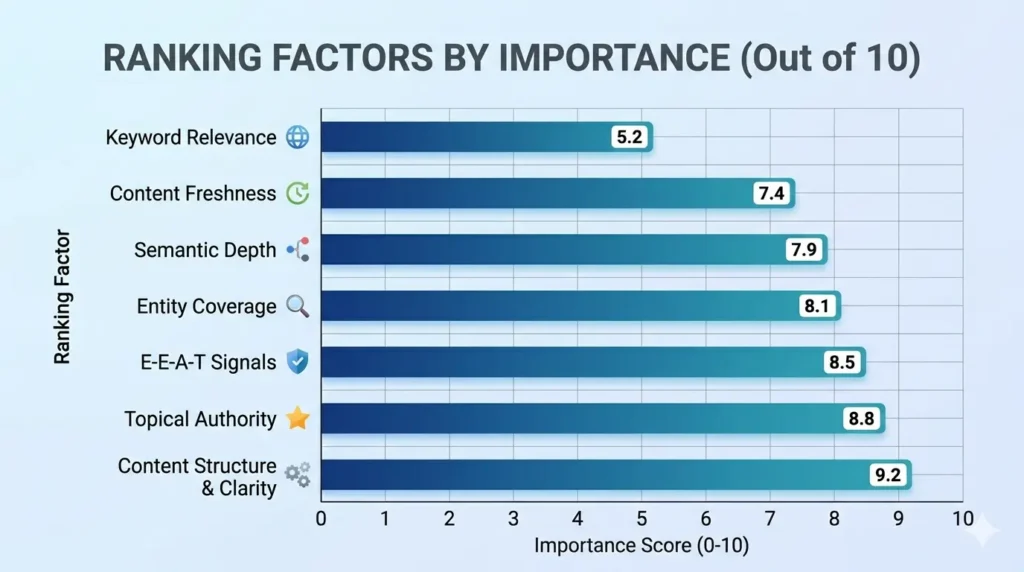
“Keyword relevance ranks last among AI source selection factors — content structure and topical authority matter far more.“
Content Clarity and Structure
AI models prefer content that clearly answers questions. Well-structured headings, concise explanations, and logical flow increase your chances of being selected.
AI models don’t reward the most keyword-rich page. They reward the most trustworthy, structured, and contextually complete one.
Entity-Based Relevance
AI systems rely heavily on entity SEO for AI search. This means they recognize concepts (brands, topics, people) and their relationships rather than just keywords.
Topical Authority
Content from websites that consistently publish high-quality, relevant content is more likely to be cited.
Trust Signals
Credible, factually accurate, and consistent content performs better. AI models favor sources that demonstrate expertise and reliability.
Semantic Coverage
Content that comprehensively covers a topic is more likely to be used in AI-generated answers. Understanding how ChatGPT and Gemini choose sources is key to building a strong AI SEO strategy.
Why Traditional SEO is Not Enough Anymore?
Traditional SEO still matters, but it’s no longer sufficient on its own. Use of AI-powered search has grown rapidly, with reports that 357% more users turned to AI search platforms in 2025 than in 2024. That shift alone is reason enough to rethink your strategy.
Here’s why:
- Ranking #1 on SERPs doesn’t guarantee visibility in Google AI Overviews and LLMs
- AI platforms summarize content instead of sending traffic directly. According to Pew Research, between 58% and 69% of users don’t click any links after receiving an AI-generated answer.
- Keyword stuffing is ineffective in AI content optimization
- Authority is now topic-based, not just page-based
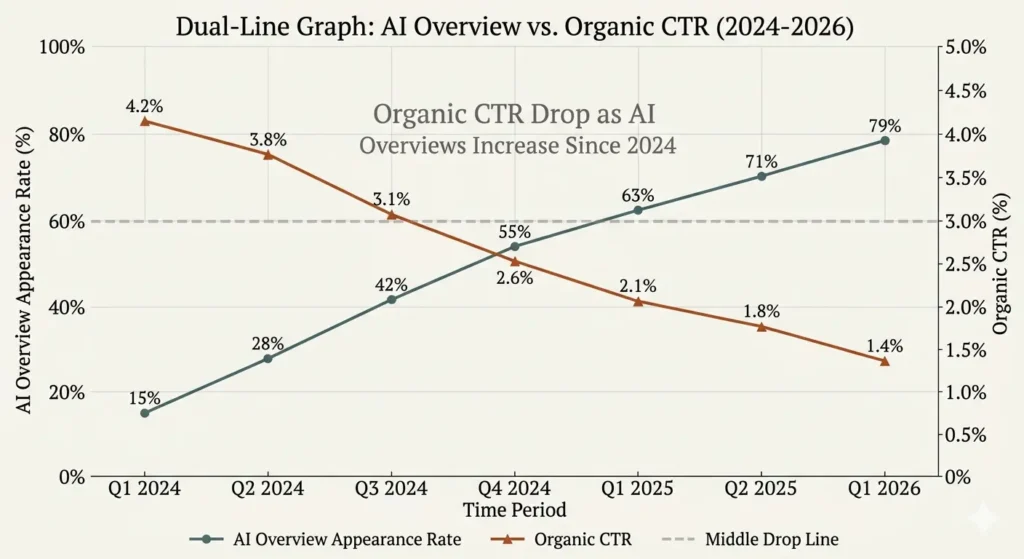
To stay competitive, businesses must combine traditional SEO with LLM optimization strategies.
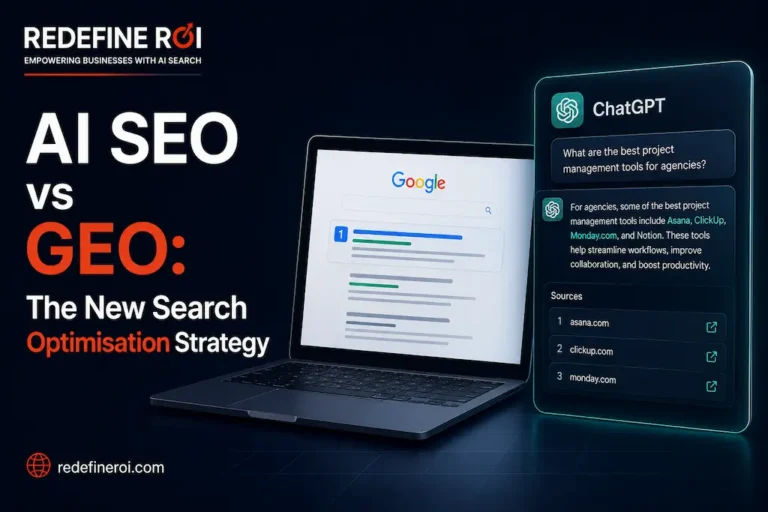
AI SEO vs Traditional SEO — Key Differences
| Factor | Traditional SEO | AI SEO |
|---|---|---|
| Primary focus | Keywords & backlinks | Entities & semantic context |
| Ranking signal | Page authority | Topical authority |
| Content goal | Drive clicks | Get cited in AI answers |
| Search format | Blue Tick Clicks | Directly generated answers |
| Optimization target | Google SERP | Google AI Overviews, ChatGPT, Gemini |
| Content structure | Keyword density | Answer-first, structured formatting |
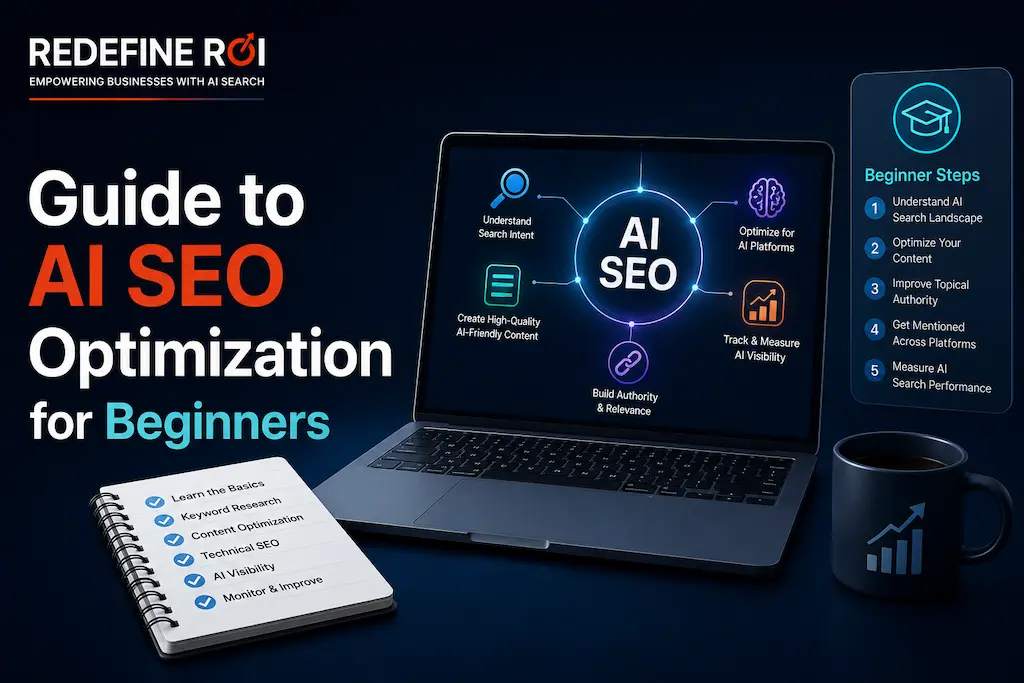
AI SEO Strategy Framework
To succeed in 2026, you need a structured approach. Below is a practical AI SEO strategy framework.
Entity SEO for AI Search
Focus on building strong entity associations. Instead of just targeting keywords, create content around:
- Topics
- Concepts
- Relationships
For example, instead of only targeting “AI SEO,” include related entities like:
- Google AI Overviews
- Semantic search
- LLMs
- AI search engines
This strengthens your content’s contextual relevance.
Create Answer-First Content
AI models prioritize content that directly answers questions.
Use:
- Clear headings (H2, H3)
- Concise paragraphs
- Bullet points for clarity
Answer queries like:
- How to rank in AI search engines in 2026
- AI SEO optimization strategies
This increases your chances of being featured in AI-generated responses.
One great blog post won’t cut it anymore. AI search engines trust websites that own a topic — not ones that occasionally write about it.
Optimize for Google AI Overviews
To optimize for Google AI Overviews, your content should:
- Provide direct, concise answers
- Include structured data where possible
- Demonstrate authority and expertise
- Avoid fluff and unnecessary complexity
Google’s AI Overviews extract content that is clear, reliable, and easy to summarize.
Build Topical Authority
Publishing isolated blog posts is no longer enough. Instead, create content clusters around core topics.
For example:
- AI SEO basics
- AI content optimization
- AI search ranking strategies
- Generative engine optimization
This signals authority to both search engines and AI models.
Use Structured and Scannable Content
AI models extract information more effectively from structured content. Best practices include:
- Short paragraphs
- Descriptive headings
- Lists and bullet points
- Clear formatting
This improves both user experience and AI search optimization.
Focus on Generative Engine Optimization
Generative search is an offshoot of search engine optimization. It focuses on optimizing content for AI-generated answers rather than traditional rankings.
Key tactics include:
- Writing summary-ready content
- Answering multiple related queries
- Including definitions and explanations
- Structuring content for easy extraction
Improve Content Depth and Coverage
Thin content will not perform well in AI search. Instead, aim for:
- Comprehensive topic coverage
- Multiple angles of explanation
- Supporting examples
AI models prefer content that provides complete, well-rounded information.
AI SEO Optimization Strategies That Work in 2026
Here are proven AI SEO optimization strategies you should implement:
- Prioritize Semantic Search: Focus on meaning, not just keywords. Use related terms and context to strengthen relevance.
- Use Simple Language: Write in a conversational tone that aligns with how users interact with AI search engines.
- Add FAQs and Direct Answers: FAQ sections improve your chances of being featured in AI-generated responses.
- Optimize for Multi-Platform Visibility: Ensure your content performs well across:
- Google AI Overviews
- ChatGPT
- Gemini
- Perplexity AI
- Bing Copilot
- Update Content Regularly: Fresh, up-to-date content signals relevance and improves visibility in AI search results.
The Role of AI SEO Services
As AI search evolves, many businesses are turning to AI SEO optimization services to stay competitive.
These services typically include:
- AI-focused content strategy
- Entity optimization
- Semantic content structuring
- AI visibility tracking
- Generative engine optimization
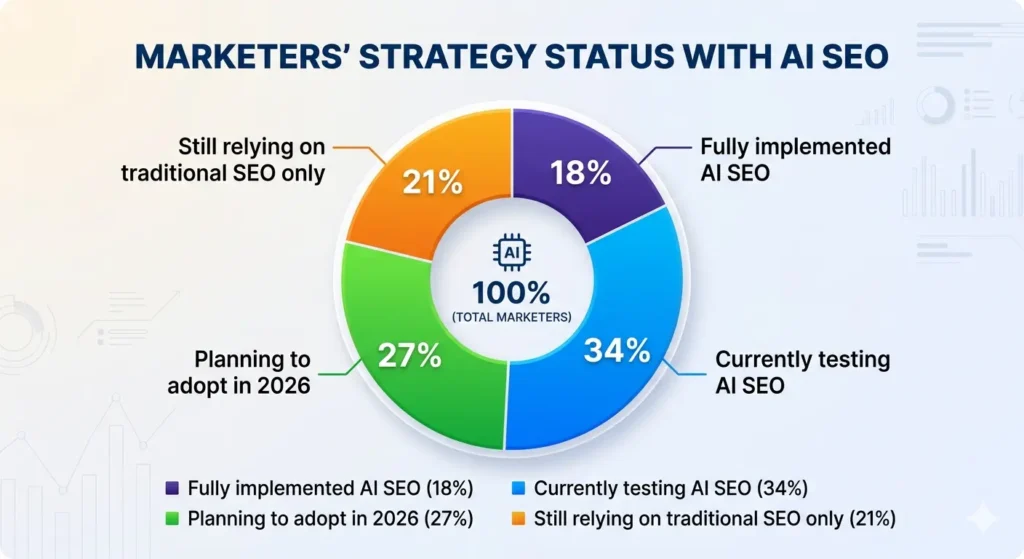
Source: BrightEdge State of AI Search Marketing 2025
Only 18% of marketers have fully implemented AI SEO strategies — leaving significant room for early movers to gain a competitive edge.
Partnering with an AI SEO optimization agency can help businesses adapt more quickly to changes in AI search rankings.
Common Mistakes to Avoid
When implementing AI SEO, avoid these common mistakes:
- Over-Focusing on Keywords: AI models prioritize meaning and context over exact keyword matches.
- Ignoring Content Structure: Poorly structured content reduces the chances of being selected by AI systems.
- Creating Thin Content: Shallow content lacks the depth needed for AI summarization.
- Not Adapting to AI Search: Relying only on traditional SEO strategies limits your visibility in AI-driven platforms.
Future of AI Search Optimization
The future of AI search optimization will continue evolving rapidly.
Key trends to watch:
- Deeper integration of AI in Google Search
- Increased reliance on LLMs for information retrieval
- More personalized AI-generated responses
- Reduced reliance on traditional search results
The rise of SearchGPT signals that OpenAI is directly competing with Google for search traffic — a shift that will reshape how content gets discovered.
Businesses that invest early in AI SEO strategy frameworks will gain a significant competitive advantage.
Final Thoughts
AI SEO is no longer optional; it’s essential. As platforms like ChatGPT, Gemini, and Perplexity AI reshape how users access information, businesses must adapt their strategies to remain visible.
By implementing the right AI SEO optimization strategies, focusing on entity SEO for AI search, and aligning with generative engine optimization, you can position your content to rank not just in search engines but in AI-generated answers.
If you’re wondering how to optimize content for ChatGPT, Perplexity in 2026, the answer is clear: Create structured, meaningful, and authoritative content that AI systems can easily understand, trust, and cite.

Mrinal Kaushik
Mrinal Kaushik is the Founder of Redefine ROI, where he helps startups, eCommerce, healthcare, and B2B brands adapt to the changing world of search. With 13+ years of SEO experience and 100+ SEO audits and campaigns across WordPress and Shopify, he works with businesses to improve their visibility not just on Google, but across AI-powered search experiences like ChatGPT, Google AI Overviews, and Perplexity. Outside of client work, he enjoys exploring how AI is changing search and sharing practical insights that help businesses stay ahead of what's next.