

Published Date: 13-05-2026, Modified Date: 13-05-2026 , Reviewed By [Mrinal Kaushik]
At Redefine ROI, we’ve run AI citation audits across 40+ B2B and e-commerce brands over the past 18 months. The single most common finding: businesses ranking on page one were invisible in AI-generated answers for the same queries. This guide is built from that same audit data.
What You’ll Learn
This guide includes key concepts and practical tactics that are making a difference in 2026.
What’s changed: AI-generated answers now handle over 80% of commercial queries that bypass the need for users to click the top 10 results – and this trend is expected to accelerate in 2026.
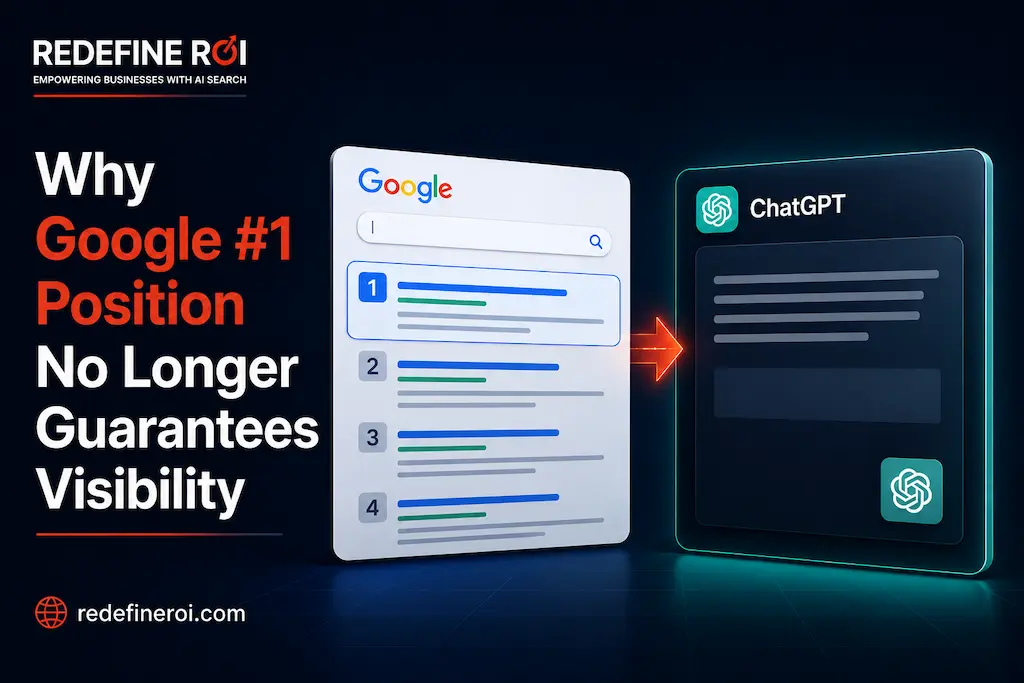
Why ranking #1 is no longer enough: An AI system can rank a #6 page above the top result if its technical SEO or content architecture is more clearly defined.
What GEO is: The emerging discipline for getting your content into AI-generated answers, different from traditional SEO.
What LLM-friendly content actually looks like: Specific structural and editorial signals that make content machine-readable for AI retrieval systems.
How to measure AI visibility: Why search console and analytics miss it and what to track instead.
What’s Changed in 2026: The Numbers Behind the Shift
- Google’s AI Overviews now appear for an estimated 47% of searches in the US, up from roughly 25% at launch in mid-2024. (SparkToro / Datos, Q1 2026)
- Organic click-through rates for informational queries dropped an average of 34% year over year in areas where AI Overviews are present. (BrightEdge AI Search Report, 2026)
- ChatGPT surpassed 700 million monthly active users by early 2026, with a growing share using it as a primary search tool for product research and how-to queries. (OpenAI investor disclosures, 2026)
What Is AI Search?
AI search refers to search interfaces that generate a synthesised, natural-language answer to a user’s query rather than returning a list of blue links. Google AI Overviews, Perplexity, ChatGPT Search, and Microsoft Copilot interpret the query, pull information from indexed or retrieved content, and recommend a filtered answer with recommended 3-5 sources.
Traditional SEO services results let users scroll through the top 10 results, whereas AI SEO optimization gives them direct answers. In response to that shift, content creators, SEOs, and brand managers need to rethink their approaches to digital visibility.
How Traditional SEO Still Works & Where It’s Breaking Down
For two decades, search discoverability has meant ranking on SERPs such as Google and Bing. Almost all SEO services provider, whether small or big, and businesses usually chase keyword positions weekly, constantly optimize webpages and fix technical issues, and know that the gap between position one and position four could mean thousands of lost visitors each month.
That approach still works – but it no longer reflects the full picture.
Traditional SEO focuses on crawlability and authority signals: backlinks, page speed, Core Web Vitals, keyword relevance, and unique meta tags.
The issue is that when AI generates the answer, ranking alone isn’t enough. A page can rank in the #1 position for a query and still not appear in the AI-generated answers, which has almost no relevance because we have seen in the past few years how organic CTR has dropped consistently when AI answers appear for any commercial queries, as users have turned down to click the top 10 Google results
What is Generative Engine Optimization (GEO)?
The term ‘Generative Engine Optimization‘ was first coined in academic research in 2024 (Princeton / Georgia Tech / Allen AI, “GEO: Generative Engine Optimisation”), and it’s now integrated into mainstream search and information retrieval systems.
“Generative Engine Optimization (GEO) is the practice of structuring the digital content and online presence so the way LLMs including ChatGPT, Perplexity, Google Gemini, Gemini and Copilot – can extract, recommend and present information in response to user queries.”
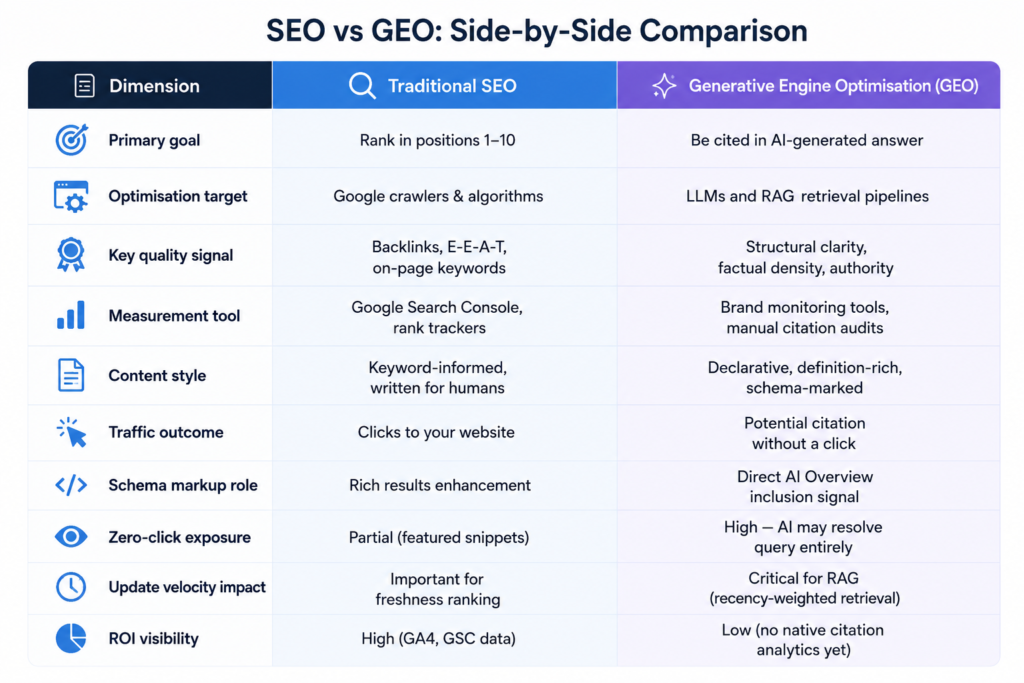
Generative SEO optimization differs from traditional SEO because it doesn’t optimise the website for keyword ranking positions. It optimizes the content for inclusion in the LLM’s response.
For example, for any query, a page rank on the third page can appear in an AI Overviews or in LLMs such as ChatGPT, perplexity because the webpage content is better structured and more clearly authoritative on that specific point.
AI Overview Growth vs Organic CTR Decline (2023–2026)
Illustrative trend showing increasing AI-generated answer coverage alongside declining organic click-through rates for informational queries.
Must Read: Generative Engine Optimziation : The Complete Guide
How Does LLM Optimisation Actually Work?
LLMs pull content and surface it through two main methods, yet most articles fail to distinguish between them clearly.
Training data inclusion
The content of the model’s weights is hard to change directly. Still, high-authority and well-cited content often ends up in training data. Clear and structured information is key.
Real-time retrieval (RAG)
Content is fetched live from the web when users query it. LLMs like Perplexity, Google AI Overviews, and ChatGPT with browse enabled do this.
For RAG systems, three key factors usually decide if content is included in the response:
Structural Clarity
-
- Use clear H2 and H3 headings.
- Define terms.
- Easy-to-read format. By doing so, it facilitates content retrieval by retrieval systems.
Topical authority: Detailed coverage backed by cited sources – not keyword density.
Direct answer placement: The answer is clear and appears right away, not hidden behind long introductions.
Sitting in the top three results isn’t enough on its own anymore. What matters more is whether your content is being understood, recommended and cited by the LLMs.
What Makes Content LLM-Citable: The Practical Signals
Content that performs well in AI search engines tends to follow a few clear patterns. These patterns recur in AI citation analysis.
Structural signals LLMs understand easily:
- H2/H3 headings using “What is X”, “How X works”, and “X vs. Y” formats
- FAQ sections with question-based headings and direct answers
- Step-by-step guide
- Every heading section opens with a clear definition block under 20-30 words
- Content must have clear tables and bullet points
Editorial signals that improve the chances of being cited:
- Claims cited to named sources with publication year
- Start with the answer, then add context
- Specific language over vague statements (“reduced by 34%” instead of “significantly reduced”)
- Keep sales-heavy language to a minimum – LLMs tend to filter out promotional copy
Technical signals for RAG pipelines:
- FAQ schema markup
- HowTo schema for process-based content
- Speakable schema for voice and AI assistant surfaces
- Visible date stamps (some retrieval systems clearly prioritise recency)
AI Search in 2026: What’s Actually Different From Last Year
In 2024 and early 2025, GEO was about optimizing content for ChatGPT, Gemini, and Perplexity to “write clearly,” “use structured data,” and “be authoritative.” That wasn’t wrong; it was incomplete.
What’s become clearer in 2026:
Recency matters explicitly.
Perplexity’s retrieval system quickly surfaces updated content. Refreshing key pages with updated data and clear date stamps can boost retrieval frequency.
The recency weighting shift in Perplexity’s retrieval is something we started noticing with clients in Q3 2025 — pages that were updated with fresh statistics were getting cited in AI responses within days of republishing.
Brand consistency is a signal.
Consistency across your website, Wikipedia article, schema markup, and third-party mentions helps AI systems better understand your brand. Inconsistent brand data reduces the chances of being cited.
AI crawlers require explicit access.
GPTBot, Google-Extended, and PerplexityBot need to be allowed in your robots.txt file. Many sites block them unintentionally, a decision worth making consciously.
The PAA-to-AI pipeline is real
People Also Ask questions strongly correlate with the types of queries AI Overviews absorb. Content that answers those questions clearly is often the same content that AI systems cite.
What This Means for Businesses Right Now
Small and medium-sized businesses face two practical challenges.
Content strategy now needs to focus on clarity for AI systems, not just search engine crawlability. Most of the required changes are editorial rather than technical: clearer headings, earlier answers, direct definitions, FAQ sections, and properly sourced claims. Those same changes also improve readability for human visitors.
How businesses measure visibility also needs to change. Standard analytics platforms don’t directly track AI citation frequency. At a minimum, businesses should manually check citation visibility in platforms like Perplexity and ChatGPT on a recurring basis.
When I work with a new client at Redefine ROI, the first thing I tell them is: don’t rebuild from scratch. In almost every audit, 20–30% of existing pages are already close to LLM-citable — they just need structural edits, not rewrites
Key Takeaways
- Entity establishment (Wikipedia, Wikidata, schema, Knowledge Graph) helps AI systems confidently identify and attribute your brand.
- AI-generated answers now handle entire query categories that previously drove organic traffic. The shift is measurable, affects industries differently, and continues to grow rapidly.
- GEO and traditional SEO are parallel disciplines, not replacements. Organic rankings still drive the majority of click-based traffic.
- LLMs favour content that’s easy to scan, interpret, and cite: clear definitions, direct answers, cited statistics, FAQ sections, and schema markup.
- A page ranked #6 can still appear in an AI answer ahead of #1–#5 if it’s more clearly structured and more specific.
- AI citations don’t always lead to clicks – but they influence brand recall and buying decisions, especially in high-consideration categories.
- Tools such as GA4/GSC completely miss AI citation visibility.
- Entity establishment (Wikipedia, Wikidata, schema, Knowledge Graph) helps AI systems confidently identify and attribute your brand.
Frequently Asked Questions
Does GEO replace SEO in 2026?
No. GEO and SEO are parallel disciplines targeting different outcomes. Traditional SEO optimizes for keyword ranking position in SERPs. GEO focuses on inclusion in AI-generated answers.
- Organic rankings generate most click-based traffic. Meanwhile, AI search optimization visibility is playing a bigger role in brand awareness and purchase decisions.

Mrinal Kaushik
Mrinal Kaushik is the Founder of Redefine ROI, where he helps startups, eCommerce, healthcare, and B2B brands adapt to the changing world of search. With 13+ years of SEO experience and 100+ SEO audits and campaigns across WordPress and Shopify, he works with businesses to improve their visibility not just on Google, but across AI-powered search experiences like ChatGPT, Google AI Overviews, and Perplexity. Outside of client work, he enjoys exploring how AI is changing search and sharing practical insights that help businesses stay ahead of what's next.