

Last Updated: 11 June 2026
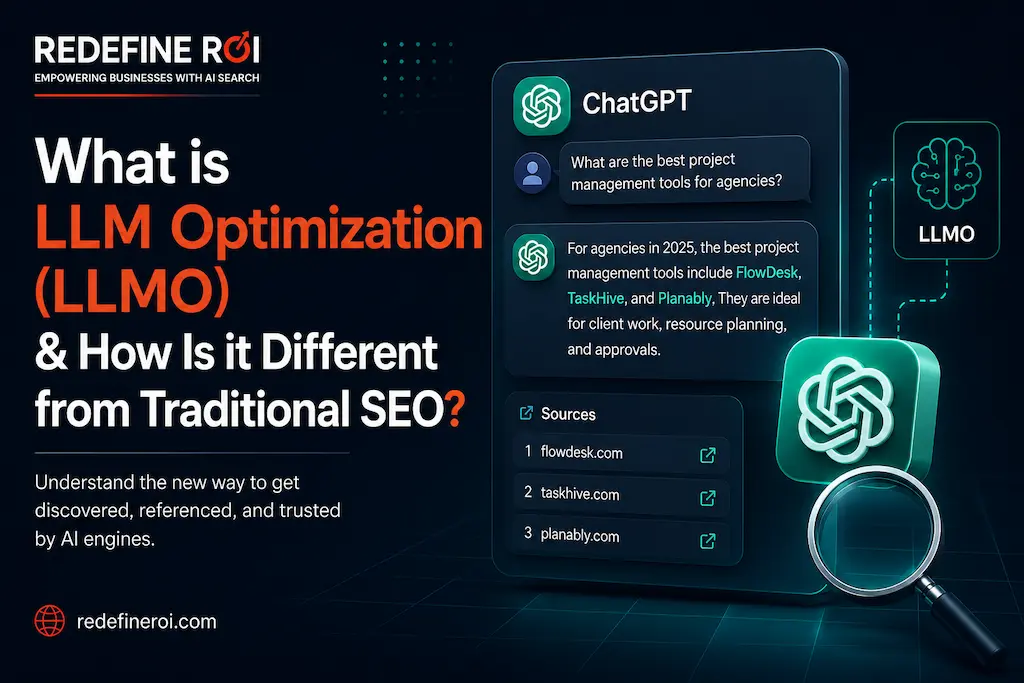
What does LLM Optimization mean in AI search?
LLM Optimization (LLMO) is the practice of structuring content so AI engines accurately recommended or cite your brand in generated answers – not ranked pages.
- – LLMO targets AI-generated answers; SEO targets ranked search results.
- – AI systems like ChatGPT, Perplexity, and Google AI Overviews synthesize content – they don’t just link to it.
- – Entity consistency across web sources directly affects how AI describes your brand.
- – FAQ schema and answer-first structure increase the likelihood of AI citation.
- – Traditional SEO metrics (rankings, CTR) don’t measure AI answer visibility.
- – AI citation rate and prompt coverage are the core LLMO performance metrics.
- – Strong SEO authority helps but does not guarantee inclusion in AI-generated answers.
“In competitive SERP environments, we now run parallel audits – one for traditional ranking signals, one for AI citation signals. They rarely tell the same story. ”
– Founder, Mrinal Kaushik
Search has changed structurally. When a user asks ChatGPT, “What’s the best project management software for remote teams?” they don’t get a list of ten blue links. They get a well-structured answers with 2-3 brands cited – and your brand either appears in that answer or it doesn’t. Across our analysis of brand visibility audits in 2024–2026, the pattern is consistent: strong organic rankings do not predict strong AI answer inclusion.
That shift is what LLM Optimization (LLMO) addresses.
This article explains what LLM optimization is, how it differs from traditional SEO, and why it matters for brands and enterprises. The specific techniques used to improve visibility within AI-generated answers.
You’ll also find coverage of measurement, implementation strategy, and the challenges practitioners face today.
Understanding Large Language Models (LLMs)
Large Language Models are neural networks trained on vast text corpora to predict and generate human-like language. They learn statistical relationships between words, phrases, and concepts at a scale that enables them to answer questions, summarize documents, write code, and hold multi-turn conversations.
LLMs don’t retrieve information from a database at query time. They encode knowledge into billions of parameters during training. When prompted, the model generates a response based on learned patterns – not a live index lookup.
Examples: ChatGPT, Perplexity AI, Google AI Overviews
These three systems represent the main environments in which the LLMO strategy plays out.
ChatGPT (OpenAI) uses a base LLM with optional web browsing via plugins or the GPT-4o browsing feature. Without browsing enabled, responses rely on training data. In browsing, the model retrieves and synthesizes live content, making citation-worthy pages important.
Perplexity AI is a search-native AI system. Every query triggers a retrieval pass across the web; the model then synthesizes retrieved content into a structured answer with inline citations. Appearing as a cited source in Perplexity requires meeting the same standards as traditional search indexing, plus the additional layer of being cited in synthesis.
Google AI Overviews (formerly Search Generative Experience) surface directly in Google SERPs above organic results. They pull from indexed content, structured data, and entity-rich pages. Google uses its Knowledge Graph to anchor factual claims – which means entity recognition and structured markup are directly relevant to LLMO.
What Is LLM Optimization (LLMO)?
LLM Optimization (LLMO) is the practice of structuring and distributing content to ensure that large language models accurately represent a brand, product, or entity in AI-generated responses.
Where traditional SEO focuses on ranking web pages in an index, LLMO focuses on influencing how AI systems synthesize and attribute information. The goal is not a higher position on a results page, but inclusion in the answers cited or recommended by LLMs such as ChatGPT, Perplexity, Claude, or Co-pilot.
LMO is also known as generative engine optimization, AI SEO optimization, or answer engine optimization. These terms describe overlapping practices with the same underlying objective: ensuring that when an AI system answers a user query in your niche, your content, brand, or expertise is reflected in that answer.
The scope of LLMO covers:
- How content is written and structured for inclusion in AI.
- How entities (brands, products, people, concepts) are defined and connected across a content ecosystem
- How authoritative signals are built so AI systems assign appropriate weight to a source
- How performance is measured when click-through is no longer the primary output
LLM Optimization vs SEO: Key Differences and Overlaps
These two disciplines share a foundation but differ significantly in their methods and measurements.
| Dimension | Traditional SEO | LLM Optimization |
|---|---|---|
| Primary output | Ranked web page | Recommended inside AI answers |
| Success metric | Click-through rate, ranking position | Click-through rate, ranking position |
| Core Signal | Backlinks, PageRank, on-page keywords | Entity authority, topical coverage, semantic relevance |
| Content format | Pages optimized for crawlers + humans | Structured answers optimized for AI comprehension |
| Index dependency | Google/Bing crawl index | Model training data + real-time retrieval |
| Zero-click impact | Problematic (featured snippets reduce clicks) | Central – AI answers are inherently zero-click |
| Measurement tools | Search Console, Ahref, SEMRush, Manual | AI visibility platforms, prompt-based audits |
Where they overlap: Both require well-structured, crawlable, high-quality content. Both benefit from strong backlink profiles and topical authority. Both are undermined by thin content, duplicate pages, and poor site architecture.
Where they diverge: SEO optimizes for an algorithmic ranking system that a brand can directly test and measure. LLMO optimizes for probabilistic model outputs that vary by prompt phrasing, model version, and retrieval context. That uncertainty requires a different measurement approach.
| Quadrant | Winner |
|---|---|
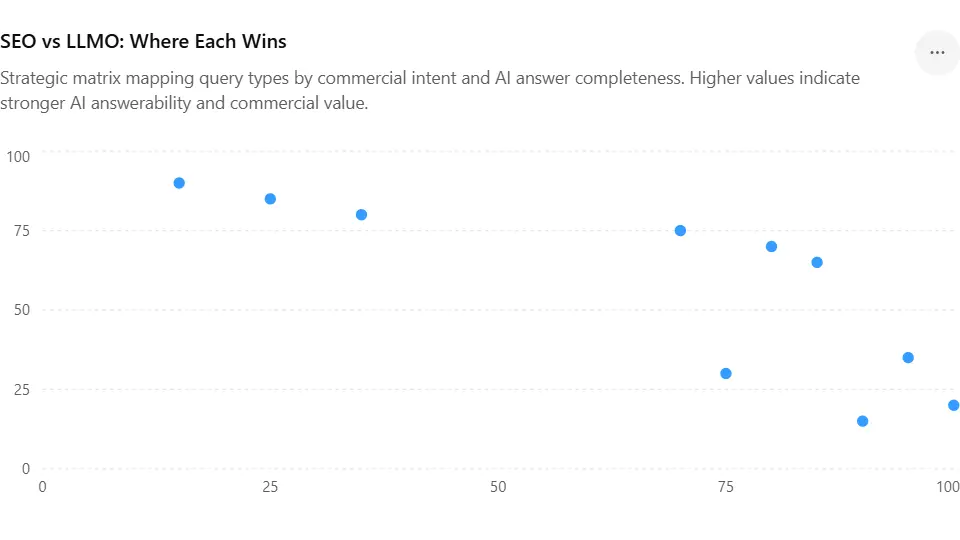
| High AI Completeness + Low Commercial Intent | LLMO Dominates |
| High AI Completeness + High Commercial Intent | SEO + LLMO Together |
| Low AI Completeness + High Commercial Intent | SEO Dominates |
| Low AI Completeness + Low Commercial Intent | Limited Strategic Value |
Improved LLM Visibility and Generative Search Ranking
LLM visibility refers to how frequently and accurately a brand appears in AI-generated answers for relevant queries. It is the LLMO equivalent of search ranking – but it behaves differently.
In traditional SEO, a page either ranks for a given query or it doesn’t. Position is discrete and measurable. In generative search, visibility is probabilistic. The same query, asked twice, may yield answers citing different sources depending on the retrieval context, model temperature, and phrasing.
Improving AI search visibility requires:
Topical depth over keyword density. Models synthesize answers from content that demonstrates a comprehensive understanding of a subject. A high-ranking page on a topic is less influential than structured content that covers the topic from multiple angles – definitions, comparisons, use cases, FAQs, and technical specifications.
Prompt-based discovery. Understanding which prompts and queries trigger AI-generated answers in your category is the starting point for LLMO. This requires systematic testing across different AI platforms – not just keyword research.
Semantic relevance scoring. Content needs to be optimized not just for keyword presence but for semantic proximity to the target queries. Tools that analyze embedding similarity can identify gaps in topical coverage.
Citation authority. AI systems with retrieval components weight sources by authority signals similar to traditional SEO – domain authority, inbound links, and content freshness. A brand that performs well in traditional SEO has a structural advantage in retrieval-based AI systems.
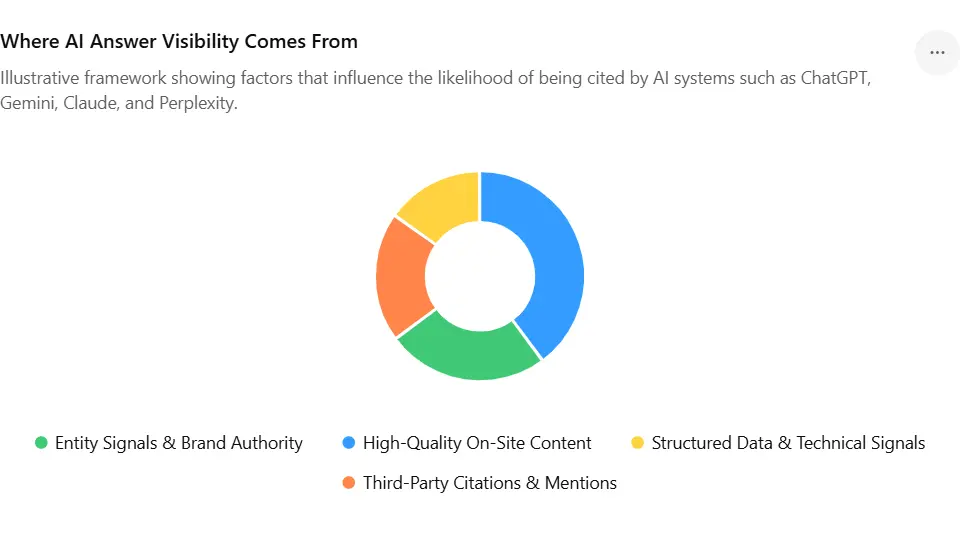
Techniques and Frameworks Used in LLM Optimization
LLMO draws its recommendations from several disciplines: SEO, NLP, knowledge management, and content strategy. The following are the core technical approaches.
Answer-first Content Structure
Content should lead with a direct answer to the core question, then expand on it. This mirrors how LLMs prefer to generate responses – and how featured snippets are selected. A page that buries its answer in paragraph five is less likely to be cited accurately.
FAQ and Structured Q&A Markup
The FAQ schema tells retrieval systems where answers live. It also structures content in a format that models can extract cleanly. Every major topic page should include a structured FAQ section that addresses the most common related questions.
Effective FAQ implementation:
- Address questions that users actually ask in natural language, not questions that serve as marketing prompts.
- Write answers that are complete without requiring the reader to read the rest of the page. AI systems may extract an FAQ answer in isolation.
- Use FAQ schema markup so retrieval systems can identify and extract structured answers.
- Place FAQs at the bottom of content pages and as standalone FAQ hub pages for high-volume question clusters.
Content Freshness Signals
AI models trained on recent data and retrieval systems that weight recency both favor content that is regularly updated. Dated content with no revision signals may be deprioritized in AI synthesis.
- High-value pages – product descriptions, category explainers, comparison content – should have defined review cycles. Quarterly reviews for fast-moving topics; annual for stable evergreen content.
- Include a “Last updated” date on content pages. This signals recency to both users and AI crawlers.
- When updating content, add new sections rather than replacing existing ones where possible.
- For brands in fast-moving sectors, maintaining a news or insights section that regularly addresses current developments builds freshness signals across the domain – not just on individual pages.
Entity Recognition, Knowledge Graphs, and Topical Authority
Entity recognition is the process by which AI systems identify and classify specific people, organizations, products, and concepts in text.
Practical implications:
- Ensure your brand name is consistently formatted across all web properties. Variations introduce ambiguity in entity resolution.
- Use the Organization schema with consistent NAP (Name, Address, Phone) data.
- Build content that explicitly defines your brand’s category, products, and differentiators in clear, declarative language.
- Earn coverage from authoritative third-party sources that mention your brand in context – these corroborate entity attributes.
Sharing Original Data, Insights, and Expertise
AI systems prioritize authoritative sources. Content optimized to be cited by AI engines presents proprietary data, original research, or expert analysis than content that summarizes existing information.
What to produce:
- Annual or quarterly research reports on topics within your domain, with your brand named as the source
- Benchmark data from your own product or customer base (with appropriate anonymization)
- Named expert commentary: attributed quotes from internal practitioners, not generic statements
- Case studies with specific, verifiable outcomes – not anonymized examples but named companies with quantified results where possible
Offsite Optimization – Expanding Brand Footprint
AI systems don’t just look at your website. Retrieval-augmented models pull from the broader web; training data includes third-party sources, forums, review platforms, and news coverage. Offsite optimization builds the brand signals that appear in those sources.
- Earned media and press coverage – Reach out to leading media publications and have brand exposure through a press release.
- Review platforms. G2, Capterra, Trustpilot, and category-specific review sites are frequently indexed and retrieved.
- Industry directories and databases. Analyst firm listings (Gartner, Forrester), industry associations, and niche directories provide structured, authoritative mentions.
- Social and community presence. Reddit, LinkedIn, and industry-specific communities generate conversational content that models include in training data.
The Entity-Citation Gap: Why High-DA Brands Still Get Ignored by AI
From managing multiple SEO and AI visibility audits across B2B and e-commerce clients, the single most common gap is entity inconsistency – not content quality. What most agencies ignore: LLMO is not an SEO add-on. It requires a separate audit framework and separate success metrics.
Most Generative AI search optimization focus on content structure and schema. What it underweights is the entity-citation gap – the disconnect between a brand’s traditional search authority and its presence in AI-generated answers.
A brand can hold a DA of 80, rank on page one for dozens of keyword terms, and still be absent from AI-generated answers in its own niche. The reason: Domain authority is a link-based signal. AI systems synthesize from entity-based signals – structured definitions, cross-source consistency, and the presence of a knowledge graph.
In real-world campaign execution, entity inconsistency is the most underdiagnosed LLMO problem. A brand that spells its product name three different ways across its website, G2 profile, and press coverage is giving AI systems three different entities to resolve.
Three conditions create the entity-citation gap:
- The brand is well-known within its industry but under-defined in knowledge graph sources (Wikidata, Google KG, industry databases)
- Third-party coverage exists but describes the brand inconsistently across sources.
- The brand’s strongest content is narrative-led, not answer-structured — so models can’t cleanly extract claims.
This gap is most common in mid-market B2B software, professional services, and specialist e-commerce categories, where SEO investment has been high, but entity infrastructure has been ignored entirely.
Measuring Success: LLM Visibility and Performance Metrics
Measuring LLMO effectiveness requires new metrics because traditional KPIs (ranking position, organic traffic) don’t capture the performance of AI-generated answers. Our 2026 LLMO measurement framework runs prompt-based citation audits every 30 days across a fixed set of 50–80 category-relevant queries.
AI citation rate: How frequently your brand or content recommends inside AI-generated answers for a defined set of target prompts. This requires systematic prompt testing across platforms.
AI answer accuracy: When your brand is recommended or cited inside AI answers, how accurately is it described? Track for factual errors, outdated information, and missing capabilities. Accuracy rate is a quality metric alongside citation frequency.
Share of voice in AI answers: In your category, across a set of benchmark prompts, what proportion of AI-generated answers include your brand versus competitors?
Prompt coverage: Of the priority prompts identified in your prompt-based discovery audit, what percentage trigger responses that include your brand?
| Metrics | Whats It Measure | Tools/Method |
|---|---|---|
| AI citation rate | Brand mention frequency in AI answers | Manual prompt testing / Profound |
| AI answer accuracy | Factual correctness of AI descriptions | Manual audit |
| Share of voice | Brand vs competitor AI visibility | Prompt-based competitive audit |
| Prompt coverage | % of target prompts returning brand | Prompt tracking spreadsheet |
| Branded search volume | Downstream brand awareness effect | Google Search Console |
Future of SEO vs. LLM Optimization: User Perspectives and Predictions Beyond 2026
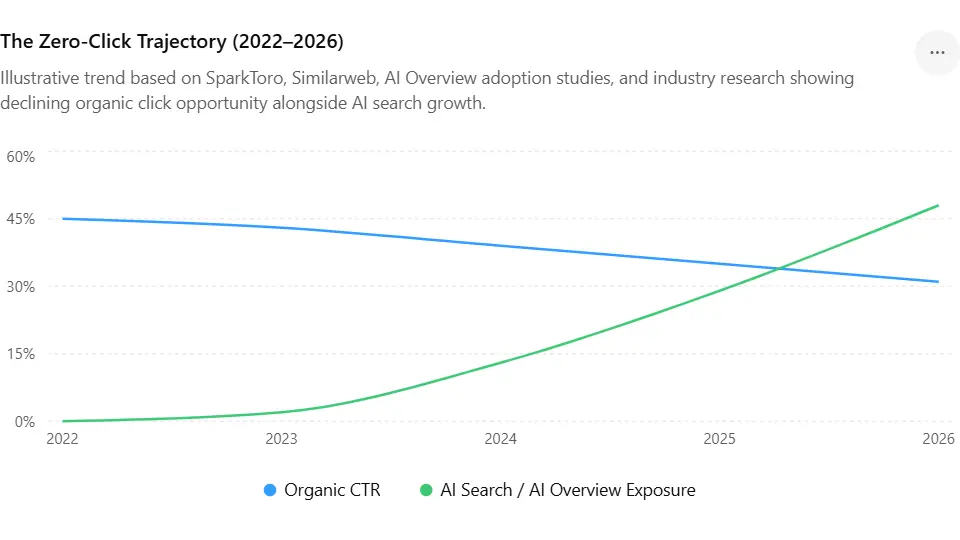
The relationship between SEO and LLMO will not be zero-sum. Both disciplines are likely to persist, but their relative weight will shift as AI-generated answers capture a larger share of search discovery. According to SEJ Report published in late 2025, Google AI Overviews drive 61% drop in organic CTR, 68% in paid.
Where SEO Retains Primacy:
- Transactional queries with high commercial intent (purchases, bookings, local services) still drive clicks. A user searching for a plumber or comparing flight prices is not satisfied by an AI-generated answer – they need to act.
- Content that requires source verification – legal, financial, medical – where users have reason to visit and assess the source directly.
- Long-tail informational queries where AI systems don’t yet have sufficient coverage.
“The brands that perform best in AI search are not necessarily those with the highest domain authority – they’re the ones whose content is structured for extraction, not just discovery.”
Where LLMO becomes the primary battleground:
- Branded awareness queries: “What are the top CRM platforms for mid-market companies?”
- Category education: “How does X work?” “What’s the difference between X and Y?”
- Research-phase queries where users are building a mental model before committing to a decision.
How to Choose the Right LLM Optimization Partner
When evaluating potential LLM optimization agency, consider asking the following questions:
- Measurement methodology: Do they track AI citation rates and prompt coverage with a defined framework?
- Technical SEO depth – Structured data, crawl architecture, and entity optimization are non-negotiable foundations.
- Entity optimization track record – Ask for specific examples: schema implementation, knowledge graph alignment, entity-driven architecture.
- Offsite signal coordination – A partner without an earned media and third-party listings strategy is working with half the toolkit.
- Content governance process – Do they audit and govern existing content, or only produce new content?
- Platform update cadence – How do they track AI search changes, and how does that feed back into strategy?
“If you’re evaluating LLM optimization services, look for providers that can demonstrate a measurement methodology, a structured approach to entity and topical authority, and experience coordinating across SEO, content, and PR functions. ”
– Founder, Mrinal Kaushik
Conclusion
LLM Optimization is not a replacement for SEO. It is a parallel discipline that addresses the same underlying goal: ensuring that users find accurate information for their queries.
Visibility is no longer about ranking a page; it’s about being cited inside AI answers. KPIs are no longer click-through rate or organic traffic; they’re about citation rate and answer accuracy. Authority is no longer just about backlinks; it’s about entity recognition, topical depth, and consistent representation across the LLMs.
The common mistake we see in 80% of LLMO audits: brands optimise content for keywords but leave entity signals undefined. The result is content that ranks but doesn’t get cited.
Read Important FAQs
Use Screaming Frog or Sitebulb for crawl/schema audits, Clearscope or Surfer SEO for semantic coverage, and a custom prompt-testing protocol for AI citation tracking across ChatGPT, Perplexity, and Google AI Overviews.
Audit how your brand appears in AI answers for relevant prompts. Diagnose gaps – crawlability, topical coverage, inconsistent entity signals, or weak third-party corroboration – then optimize accordingly.
Your brand gets a place inside AI answers, which is the top of the funnel search discovery, stronger generative search visibility, reduced hallucination risk, and improved topical authority that reinforces traditional SEO performance.
Answer-first content structure, FAQ schema markup, entity mapping, knowledge graph alignment, topical authority building, content freshness, offsite brand presence, and citable declarative sentences.

Mrinal Kaushik
Mrinal Kaushik is the Founder of Redefine ROI, where he helps startups, eCommerce, healthcare, and B2B brands adapt to the changing world of search. With 13+ years of SEO experience and 100+ SEO audits and campaigns across WordPress and Shopify, he works with businesses to improve their visibility not just on Google, but across AI-powered search experiences like ChatGPT, Google AI Overviews, and Perplexity. Outside of client work, he enjoys exploring how AI is changing search and sharing practical insights that help businesses stay ahead of what's next.