
Quick Answer: Why Brand Does Not Show Up in ChatGPT
Ranking on Google doesn’t get you cited by AI. Here’s what does:
- ChatGPT often skips brands it can’t reach, quote, or confirm elsewhere.
- Retrieved ≠ cited. ChatGPT retrieves more pages than it cites. Studies put the cited share between roughly 15% and 50% (AirOps, Ahrefs). Be quotable, not just findable.
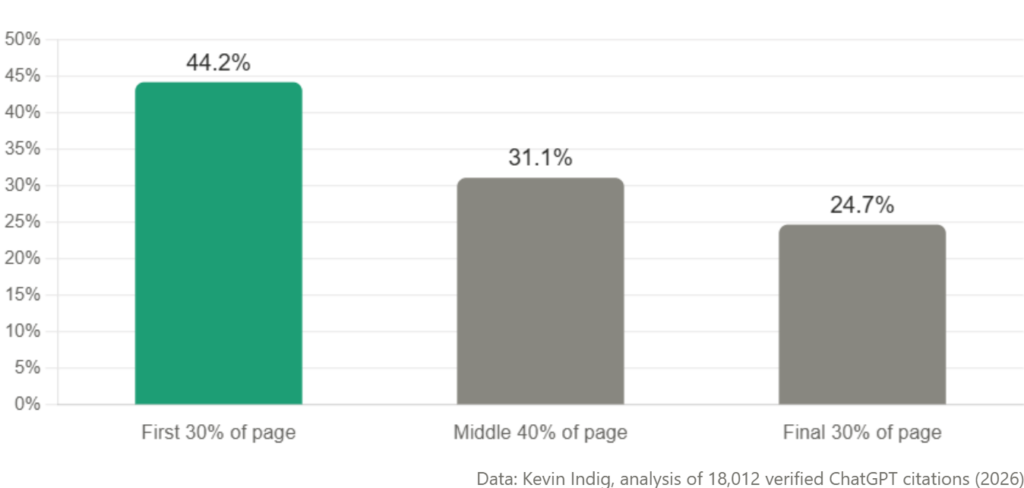
- The top of your page gets the most citations. One analysis found 44.2% of ChatGPT citations came from the first 30% of a page (Search Engine Land). Bury the answer, and you give ChatGPT less to quote.
- One source is an opinion. Three sources are a fact. ChatGPT only repeats what the web agrees on.
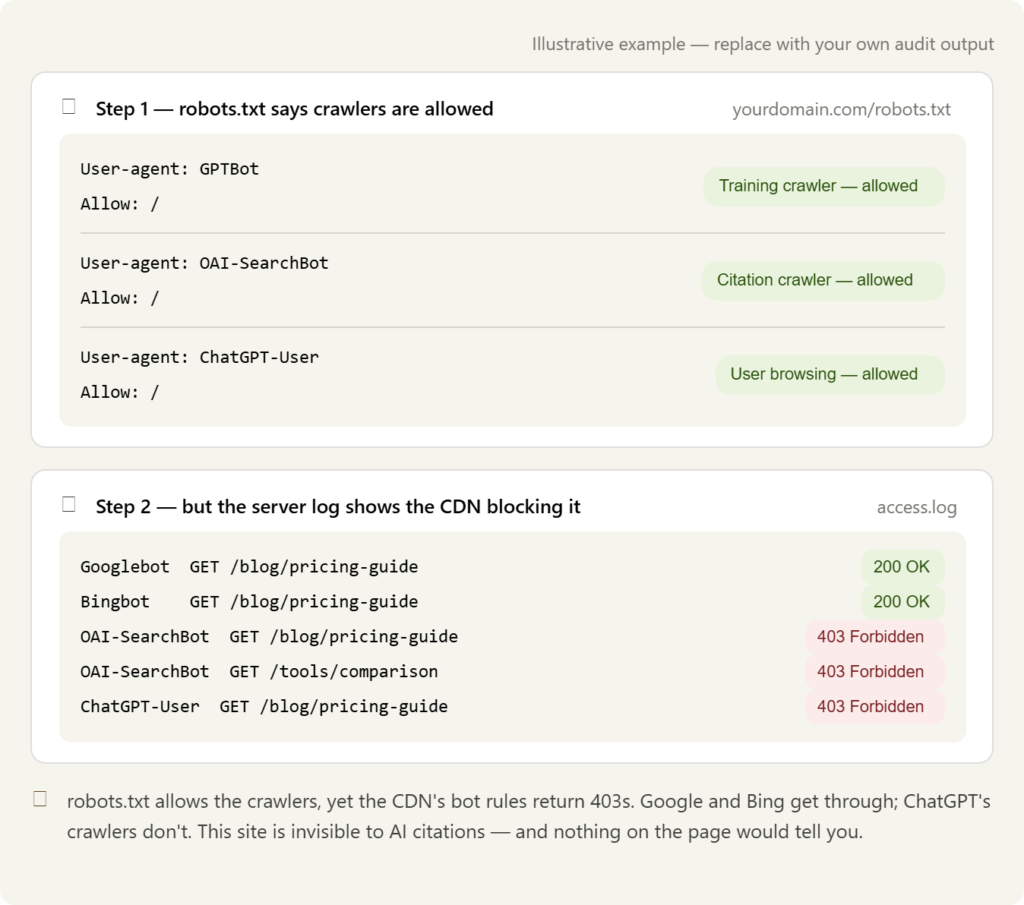
- You might be blocked without knowing it. A CDN rule against OAI-SearchBot can cut you off from ChatGPT search even when robots.txt allows it.
- Check Bing as well as Google. ChatGPT search is widely reported to use Bing’s index, and a Google ranking alone doesn’t decide citation.
- Borrow authority; don’t only build it. A claim that appears only on your own site is easier to skip than one independent sources repeat. Get into the pages ChatGPT already cites.
If your brand isn’t showing up in ChatGPT, the cause is often one of several: blocked AI crawlers, weak Bing presence, a buried answer, schema gaps, thin topical authority, few third-party mentions, inconsistent brand signals, or stale content. Each can be checked; no fix guarantees a mention.
Three outcomes get lumped together as “showing up.” A mention is ChatGPT naming your brand, usually without a link. A citation is a linked source in the answer. A recommendation is ChatGPT suggesting your brand as an option for the user’s need. You can have one without the others.
If your problem is that ChatGPT never cites your website, there are many reasons.
ChatGPT answers in prose, names brands, and links to a handful of sources. Adobe Analytics reported 693% in the Nov–Dec 2025 holiday season, and those visitors converted 31% more than other traffic sources. Our research on AI-driven B2B search in India projects that half of B2B search journeys will run through AI by 2027.
How Do I Know If My Content Is Cited In ChatGPT Answers?
To check whether ChatGPT is skipping your brand or not, run the questions your buyers actually ask, with web search on and off, in a clean session. Repeat each prompt a few times, because answers vary. Log whether your brand was mentioned, cited, or recommended; record every source URL; and note which competitors appeared.
- Write buyer-style prompts. Use questions a customer would type, not your own keyword list. Include one that asks for a recommendation and one that asks for an explanation. An explanation question may not name any brand, so a miss there tells you less.
- Run each prompt with web search on, then off. Without search, ChatGPT answers from training data and rarely links. With search, it retrieves pages and may cite them – a brand that shows up in one mode and not the other points to different causes.
- Repeat each prompt a few times in a fresh session. Answers change from run to run, so a single miss proves little.
- Log what you see. For each run, record the prompt, date, search on or off, whether your brand was named, linked as a source, or recommended, every source URL shown, and the competitors that appeared.
- Compare against two or three competitors. Note which pages ChatGPT cites for them and not for you, then match your log to the table below.
Two users can get different answers to the same question. ChatGPT adjusts to conversation history, stored memory, custom instructions, the user’s location and language, and prompt wording. A user who has spent the session on enterprise software gets enterprise-leaning recommendations. A user who asked about budget tools gets budget options.
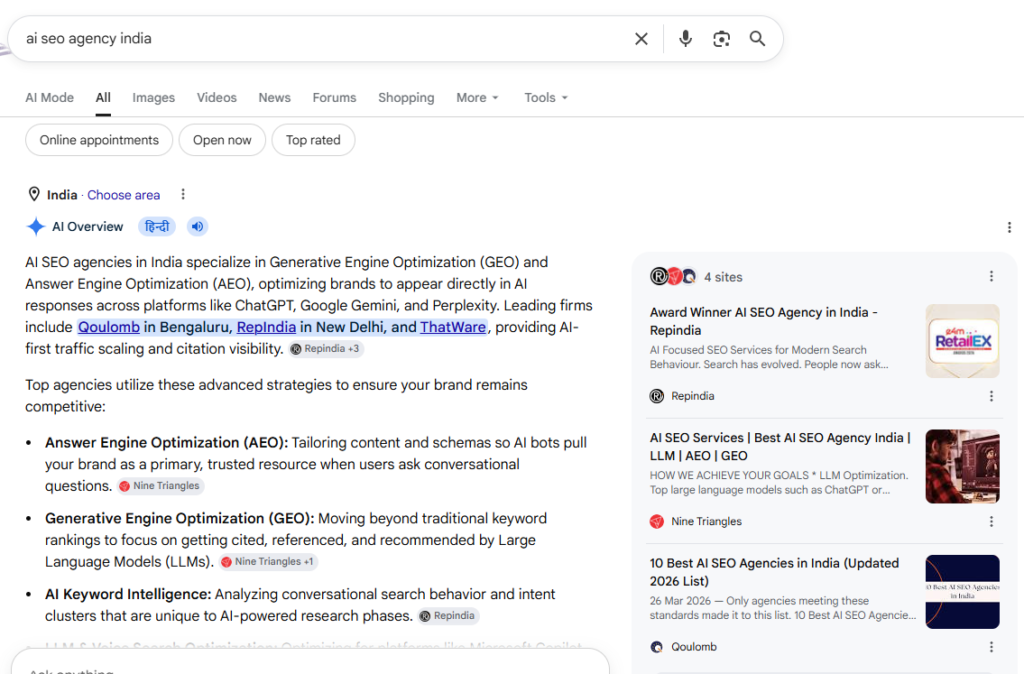
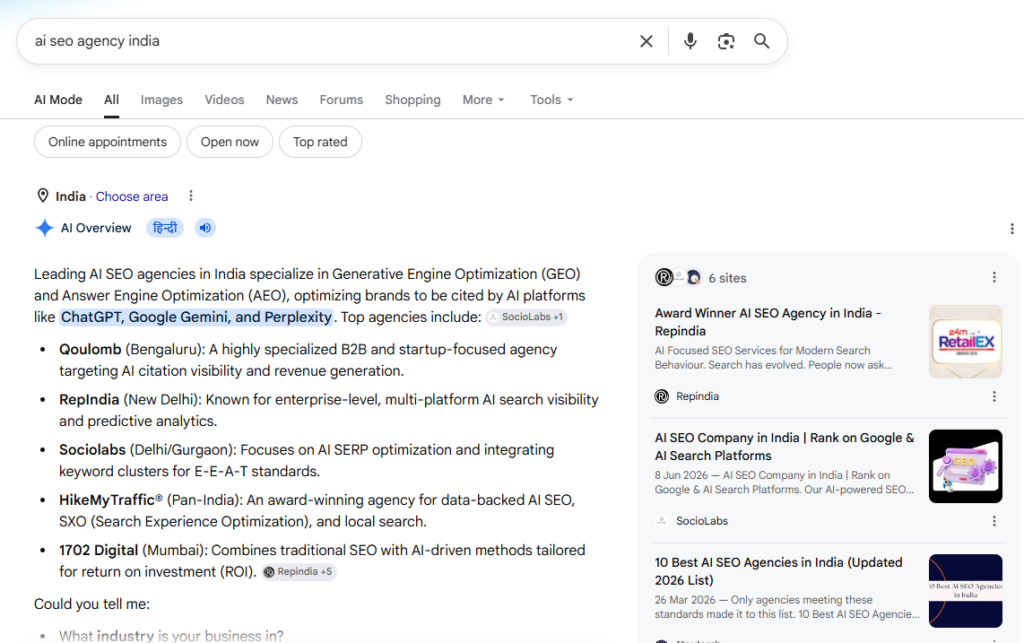
Google AI Overviews vary too. I ran the same prompt twice, less than a minute apart, and the overview cited different sources each time. In the first run, the overview recommended websites with links and then described the strategies brands use. In the second, it led with the strategies and then listed SEO agencies with no links. This was a Google test, so it shows how much AI answers can shift, not how ChatGPT behaves.
Quick Diagnosis: What You See and What to Check
Match what you logged to the closest row. Numbers refer to the causes below.
| What you see | Likely cause | What to check |
|---|---|---|
| Your pages never appear among the sources, even for prompts they answer directly | Blocked or unreachable for ChatGPT’s crawler (cause 1) | robots.txt rules for each OpenAI user agent, CDN and WAF bot rules, and what your server returns to OAI-SearchBot |
| Competitors appear, and your pages are missing or poorly placed in Bing | Weak Bing presence (cause 2) | Bing Webmaster Tools verification, sitemap submission, and whether your key pages are indexed in Bing |
| ChatGPT cites a competitor page that answers the same question more directly | Answer buried too deep (cause 3) | The first sentences under the matching heading on both pages |
| Competitors appear across several review sites, lists, or articles, and you appear in none | Few third-party mentions (cause 6) | The sources ChatGPT lists for competitors, and whether you could be listed there accurately |
| ChatGPT describes a different company or mixes up your products | Inconsistent or ambiguous brand signals (cause 7) | Your name, category, and description across your site and profiles, and whether your name is a common word |
| Your brand appears with search on but not off, or the reverse | Training-data gap versus retrieval gap | If search-off omits you, see “When Not Showing Up Is Expected.” If search-on omits you, start with causes 1–3. |
| Newer pages on your topic are cited and yours is not | Possibly stale content (cause 8) | Whether your page’s facts, dates, and sources are current |
Key Reasons Why Brand Does Not Show Up In ChatGPT
1. Your Content Is Blocked from AI Crawlers
If ChatGPT’s search crawler can’t fetch your pages, it can’t cite them from live retrieval, no matter how good the content is. Check three things: the robots.txt rules for each OpenAI user agent, any CDN or firewall rule that returns an error despite robots.txt, and what your server actually sends to OAI-SearchBot.
Sites can block GPTBot, OAI-SearchBot, or other AI user agents in robots.txt, sometimes deliberately, often through inherited defaults or a CDN’s bot-protection rules. If OAI-SearchBot cannot fetch your pages, you cannot be cited from live retrieval, regardless of content quality. OpenAI documents what each crawler does in its bot documentation.
2. Weak Bing Presence
Bing visibility can matter for ChatGPT citations, because ChatGPT’s live search is widely reported to draw on Bing’s index. Google rankings matter too. Verify your site in Bing Webmaster Tools, submit your sitemap there, and check that your key pages are indexed in Bing.
If you’ve only worked on Google, check Bing too. If your site has never been verified in Bing Webmaster Tools, has no sitemap submitted there, or ranks poorly on Bing for your category keywords, you may start behind. Google still counts: AirOps found pages ranking #1 in Google were cited 43.2% of the time, about 3.5 times as often as pages outside the top 20.
3. Your Answer Is Buried Too Deep
One analysis of ChatGPT citations found 44.2% came from the first 30% of a page, 31.1% from the middle, and 24.7% from the final 30%. That’s a correlation, not a rule, but it supports answering the question near the top of the page and of each section (Kevin Indig’s analysis).
If your page opens with “Pricing depends on many variables” and doesn’t give actual numbers until paragraph nine, ChatGPT finds nothing worth quoting at first. A page that answers each heading’s question in its first sentences gives ChatGPT something it can lift.
4. Schema Markup and Structured Data Gaps
Schema isn’t required to appear in Google’s AI Overviews, and the evidence that it affects ChatGPT citations is mixed. It can still clarify what a page is and who published it. Mark up only what’s visible on the page, and treat schema as support for good content, not a substitute. Google’s AI features documentation says no special markup is required for AI Overviews.
Structured data tells machines what your content is, not just what it says. Article and Organization markup state the page type and the publisher plainly. FAQPage markup fits only where the page shows real question-and-answer sections. For brand-name and entity problems, see cause 7.
5. Lack of Topical Authority or Recognized Expertise
Citations in ChatGPT appear to cluster around sites that cover a topic broadly: one analysis found about 30 domains took 67% of citations in the product-comparison topics it studied. A site with two posts on a subject has little presence. One with linked articles on selection, migration, pricing, and integrations has more.
6. Few Third-Party Mentions and a Thin Web Footprint
ChatGPT appears more willing to repeat a claim it can confirm in several independent places. If your brand shows up only on your own site, it has nothing to corroborate. Review sites, best-of lists, comparison articles, industry publications, and community threads each add an independent source.
If your site says you’re a leading vendor and no one else does, that’s uncorroborated marketing copy. Check where you appear: review-platform profiles (for example, G2 or Trustpilot, where they fit your category), directory listings, press coverage, and community discussion. Each gap removes a place where ChatGPT could find and corroborate your brand. Brands listed in best-of lists, comparison articles, and industry publications give ChatGPT several independent signals about the same entity, and may be more likely to be named.
7. Inconsistent or Ambiguous Brand Signals
If your brand’s name, category, or description differs across your site, social profiles, and directories, ChatGPT may struggle to treat them as one company. A common-word name adds risk. Use the same name and a plain description everywhere you control, and link your profiles to each other.
To check, search your exact brand name and see whether the results describe you or someone else. Consistent Organization markup, with sameAs links to your social profiles, your Wikipedia or Wikidata entry (if you have one), and key directories, helps AI systems connect scattered mentions into one identity.
8. Stale Content
Freshness can matter when ChatGPT searches the web, but it isn’t the only factor, and older pages still get cited. Show real publish and update dates, and refresh the facts behind them. Changing a date without changing the content adds nothing and can hurt your credibility.
When Not Showing Up Is Expected
It’s normal for ChatGPT not to name your brand. The question may ask for an explanation rather than a recommendation. Your brand may be new or thinly covered, or the category may be crowded with long-established names. Run the check, fix the causes above, and expect gradual change.
- The question doesn’t call for a brand. Explanation questions often get no names.
- Your brand is new. Without search, ChatGPT relies on what it learned in training, so a brand launched after that data was collected can be absent from those answers.
- The category is crowded. Established names often have more mentions and coverage.
Understanding ChatGPT’s Role in AI Search Visibility
How ChatGPT Sources and Cites Information in Its Responses
ChatGPT pulls answers from two layers, and the distinction determines whether your brand gets cited.
The first layer is training data: a static snapshot of the web learned before the model’s knowledge cutoff. When ChatGPT answers from training data alone, it may name a brand without linking to it. That is a mention, not a citation.
The second layer is live retrieval. When a query needs current information, such as comparisons, pricing, “best X” questions, or anything with a recent date, ChatGPT runs a web search, evaluates pages, and cites the few it can confidently attribute information to.
Retrieval is selective. An Ahrefs study of 1.4 million ChatGPT prompts found that titles, snippets, and URLs shape which results get opened. Pages with descriptive URL slugs were cited 89.78% of the time they appeared in results, versus 81.11% for less descriptive ones. This is a correlation. Your title tag and URL may be doing citation work before ChatGPT reads a single paragraph.
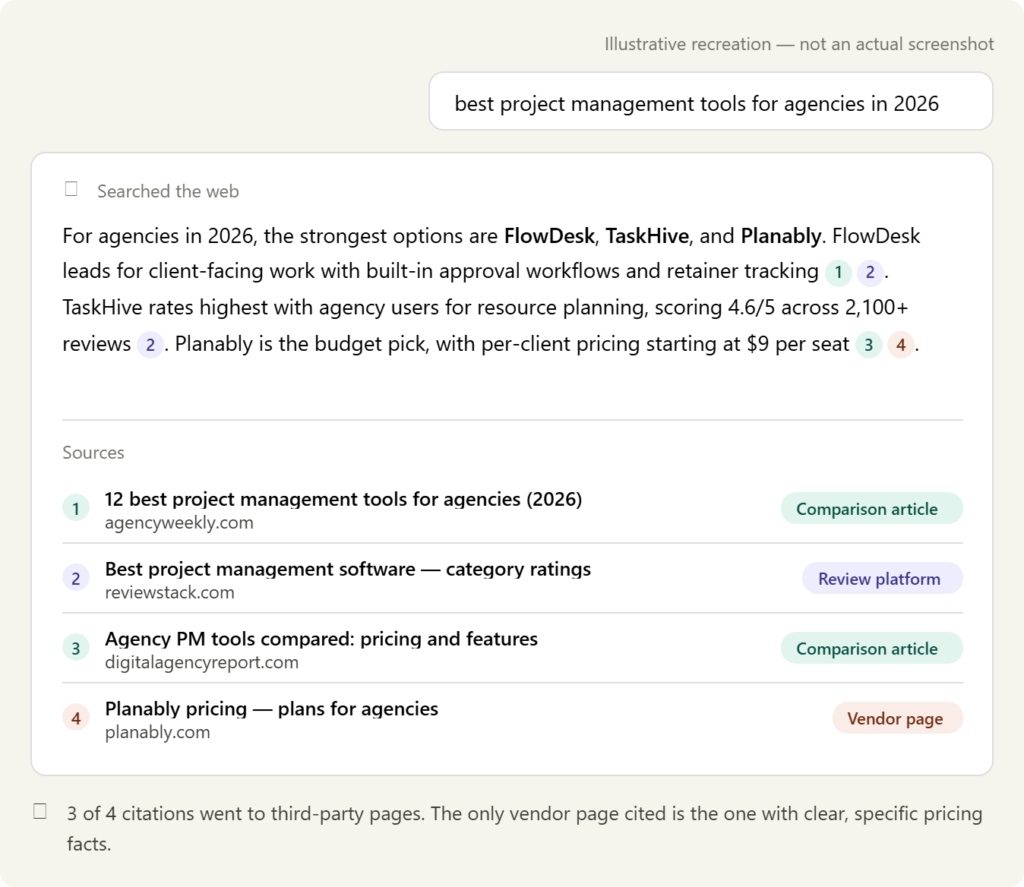
For example, a question like “best project management tools for agencies in 2026” is a buying question, so ChatGPT will often run a live search (illustrative).
Why Brand Mentions and Credibility Matter in LLMs
Large language models are trained on relationships among entities. If your brand is mentioned across many credible platforms, such as industry publications, review sites, directories, and forums, the model may learn that association and be more likely to name your brand.
Getting retrieved is not the same as getting cited. Your page can shape ChatGPT’s understanding of a topic and still appear nowhere in the answer.
Credibility is also concentrated. Kevin Indig’s analysis found that about 30 domains accounted for 67% of citations in the product-comparison topics he studied. ChatGPT seems more willing to repeat claims it finds in several places. If a claim appears only on your website, it’s just your word. If the same claim also appears on a review site, a press release, and a comparison article, ChatGPT has more reason to repeat it. Brand mentions, even unlinked ones, may matter more in AI search than in traditional SEO, where links carried most of the value. See cause 6 above for where to look.
Shaping how language models learn and repeat these associations is a discipline in itself. Here’s our full breakdown of LLM optimization.
Comparing ChatGPT AI Visibility With Other AI Tools
AI answer engines differ in how they retrieve pages, when they cite, and which levers tend to matter. Treat the table as a starting point, as of October 2026.
| Criteria | ChatGPT | Google AI Overviews / Gemini | Perplexity |
|---|---|---|---|
| Retrieval index | Widely reported to use Bing’s index, plus OpenAI’s own crawling (OAI-SearchBot) | Google’s index and ranking systems | Its own crawler (PerplexityBot) plus search partnerships |
| When it cites | Cites when web search fires; often no citations on training-data answers | Usually links sources; in one of our two test runs, the overview listed agencies without links | Designed to show sources with answers |
| Link to existing rankings | One study: pages ranking #1 in Google were cited 43.2% of the time, about 3.5x pages outside the top 20 | Often overlaps with top organic results; the amount varies by study | Reported as moderate |
| Levers to check first | Crawler access, Bing visibility, answer-first content, third-party corroboration | Standard Google SEO, indexing and snippet eligibility, E-E-A-T | Crawl access and current, fact-dense pages |
Optimizing Your Website for Recommendations in ChatGPT
Each fix below maps to a cause above. The fixes cover the ChatGPT-specific layer and sit inside the wider practice of generative engine optimization. For the broader playbook, see our guide to optimizing content for AI search engines.
Ensuring Accessibility to AI Crawlers and Bots
- Open robots.txt and confirm you are not blocking GPTBot (training), OAI-SearchBot (ChatGPT search retrieval), or ChatGPT-User (user-initiated browsing).
- Check your CDN/WAF (Cloudflare, Akamai, and similar) bot-management rules. They can challenge or block AI crawlers even when robots.txt allows them.
- Test what your server returns: request a page using OAI-SearchBot’s user agent and compare the response with what Googlebot gets.
- Optional: an llms.txt file listing your key pages. The evidence that AI systems use it is mixed, so treat it as low priority.
Structured Data, Schema, and Technical SEO Essentials
Useful additions, none required for citation:
- Organization and Article schema, to state the page type and publisher
- FAQPage schema only where the page shows real question-and-answer sections; optional
- Product and Review/AggregateRating schema where applicable
- Clean semantic HTML: single H1, descriptive H2/H3 hierarchy, real table elements for comparisons, and lists marked up as lists
Technical SEO: fast server response time, content rendered in HTML (not client-side JavaScript only), descriptive URL slugs, and an XML sitemap submitted to both Google Search Console and Bing Webmaster Tools. Schema supports good content; it doesn’t replace it (see cause 4).
Targeting Informational Queries and Featured Snippets
- One analysis found citations skew toward the top of the page and toward direct definitions.
- Write H2s and H3s as the questions users actually ask (“How much does X cost?”, “Is X better than Y for Z?”).
- Answer in the first one to two sentences under each heading, then expand.
- Front-load: put your most citable claims early, where one analysis found 44.2% of citations originated, ideally in a TL;DR or summary block. That’s a correlation.
- Add People Also Ask questions for the exact phrasings to target.
Building High-Quality Backlinks and Brand Mentions
For AI visibility, which pages mention you probably matters more than how many do. The best targets are pages ChatGPT already cites: comparison articles, “best of” roundups, and review platform pages. Unlinked mentions can still help, since answers draw on text, not only links.
Run your niche prompts through ChatGPT and Google with web search enabled, note which third-party pages are cited repeatedly, and try to get published on them. Community threads can shape answers even when they aren’t credited as sources, so take part honestly and only where you can add something useful. Repeating a finding in another format, like a video or podcast, puts it on more surfaces, but earning mentions on pages ChatGPT already cites comes first.
Important FAQs
What is the fastest way to get my brand cited by ChatGPT?
A common fast route is to appear on third-party pages ChatGPT already uses as sources, such as comparison articles, “best of” roundups, and review platforms in your category. This can be quicker than building your own domain authority, though neither route is guaranteed.
- Run your buyer prompts in ChatGPT with web search enabled. Note which pages it cites repeatedly.
- Pitch your content to get your brand included in those exact pages.
- Restructure key pages to answer questions in the first two sentences under each heading.

Mrinal Kaushik
Mrinal Kaushik is the Founder of Redefine ROI, where he helps startups, eCommerce, healthcare, and B2B brands adapt to the changing world of search. With 13+ years of SEO experience and 100+ SEO audits and campaigns across WordPress and Shopify, he works with businesses to improve their visibility not just on Google, but across AI-powered search experiences like ChatGPT, Google AI Overviews, and Perplexity. Outside of client work, he enjoys exploring how AI is changing search and sharing practical insights that help businesses stay ahead of what's next.