Last Updated: 13 June 2026
Review by Mrinal Kaushik
Why ChatGPT Ignores Your Brand?
Ranking on Google doesn’t get you cited by AI. Here’s what does:
- Retrieved ≠ cited. ChatGPT reads up to 7x more pages than it credits. Be quotable, not just findable.
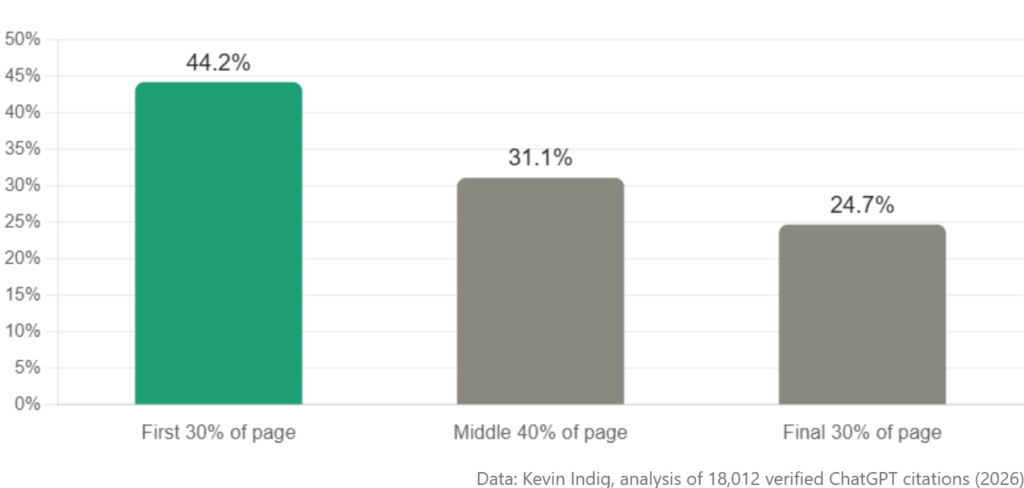
- The first 30% of your page wins 44% of citations. Bury the answer, lose the citation.
- One source is an opinion. Three sources are a fact. ChatGPT only repeats what the web agrees on.
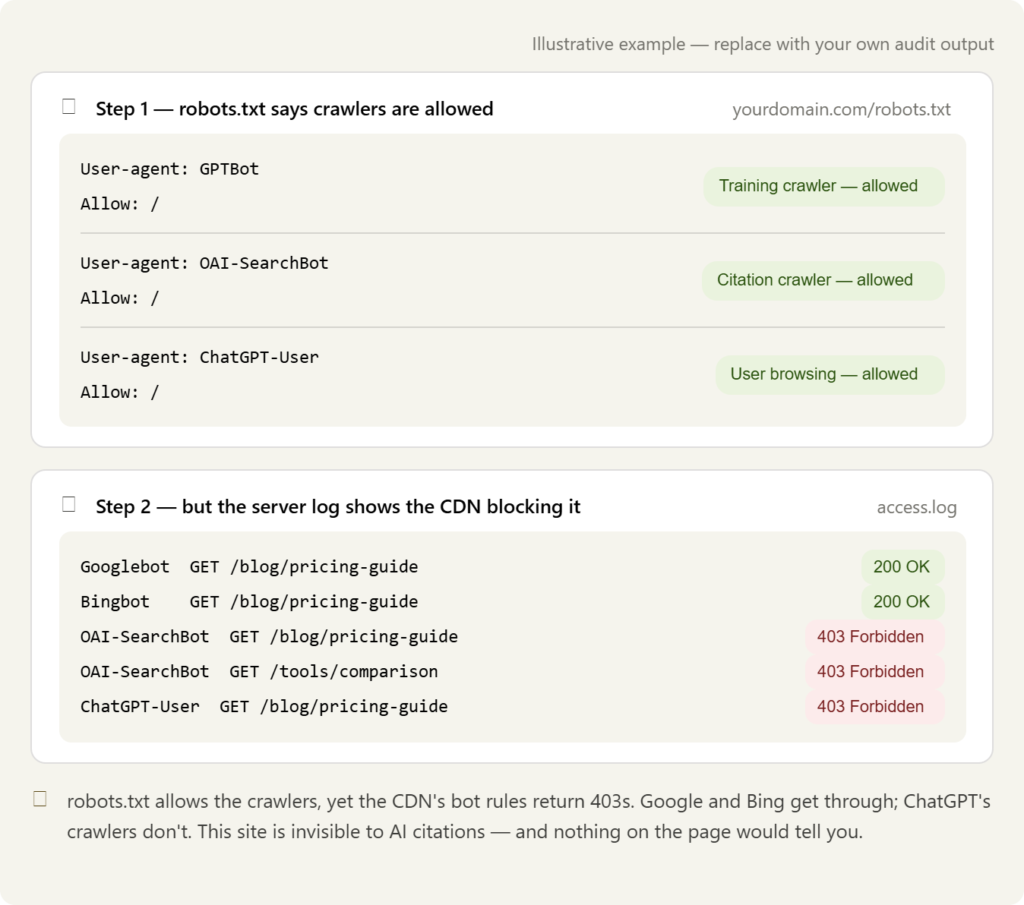
- You might be blocked and not know it. One CDN rule against OAI-SearchBot = invisible, forever.
- ChatGPT searches Bing, not Google. Your Google rankings don’t follow you here.
- Don’t build authority ‐ borrow it. Get into the pages ChatGPT already cites.
ChatGPT answers questions in prose. It names brands, recommends tools, and links to a handful of sources. The stakes are no longer theoretical: Adobe Analytics measured a 693% year-over-year jump in AI-referral traffic to US retail sites during the Nov–Dec 2025 holiday season – and those visitors converted 31% better than traffic from other sources.
The shift is steeper in B2B. Our own research on AI-driven B2B search in India projects that half of B2B search journeys will run through AI by 2027 – meaning the buyers most likely to never see your Google ranking are the high-value ones.
The reasons are usually identifiable: weak topical authority, content that the model cannot retrieve or extract, missing structured data, or a thin footprint across the third-party sources ChatGPT trusts. Each of these is fixable.
This guide explains how ChatGPT selects and cites sources, the specific reasons brands get skipped, and the technical and content changes that improve your odds of being mentioned and cited.
Understanding ChatGPT’s Role in AI Search Visibility
How ChatGPT Sources Cites Information in Its Responses
ChatGPT pulls answers from two layers, and the distinction determines whether your brand gets cited.
The first layer is training data: a static snapshot of the web learned before the model’s knowledge cutoff. When ChatGPT answers based solely on its training data, it may mention a brand only by name and rarely include a link. That is a mention, not a citation.
The second layer is live retrieval. When a query needs current information – comparisons, pricing, “best X” questions, anything with a recent date – ChatGPT runs a web search, evaluates pages, and cites the few it can confidently attribute information to.
Retrieval is selective. Recent research using Ahrefs’ data shows that ChatGPT decides which search results to open based on the title, snippet, and URL. Pages with clear, descriptive URL slugs were cited 89.78% of the time, compared with 81.11% for pages with vague slugs. Your title tag and URL are doing citation work before a single paragraph is evaluated.
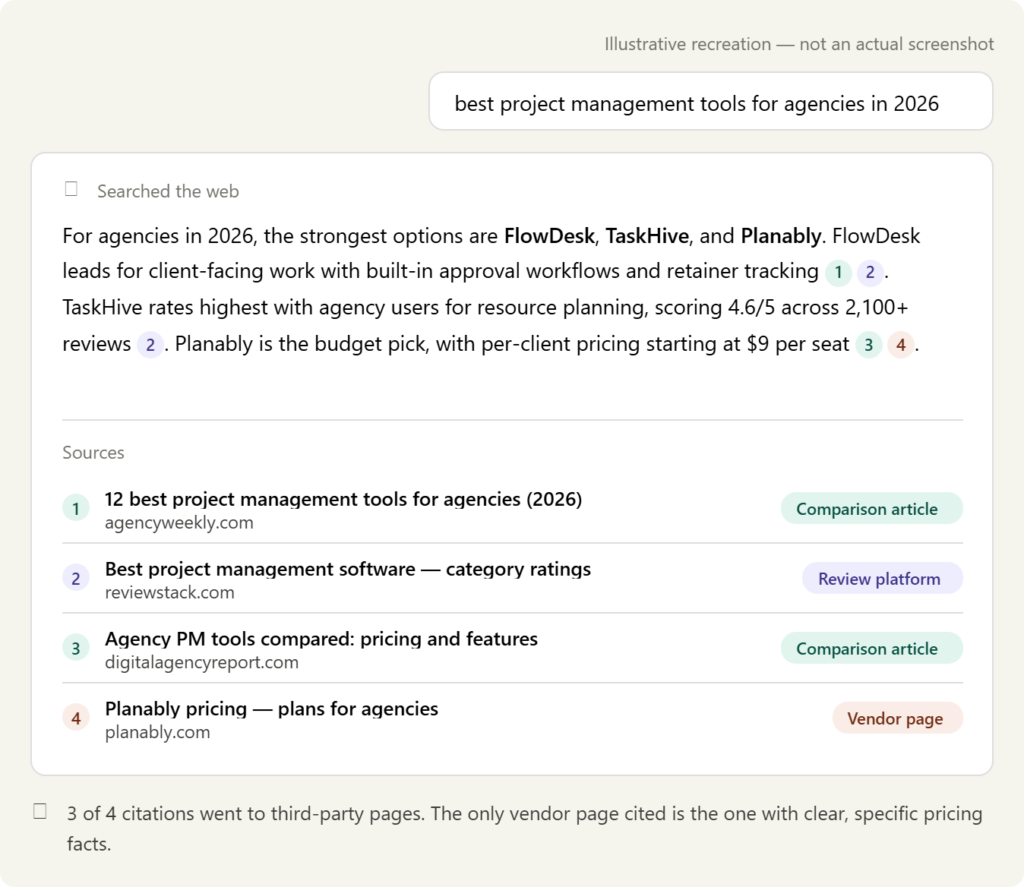
Example: A user asks, “What are the best project management tools for agencies in 2026?” ChatGPT sees this as a buying question, so it runs a live web search. It scans the titles and snippets of results, opens the pages most likely to answer the question, and builds a response citing a handful of them – usually comparison articles, review sites, and one or two vendor pages with clear facts.
Why Brand Mentions and Credibility Matter in LLMs
Large language models are trained on relationships among entities. If your brand is mentioned across thousands of credible platforms-industry publications, review sites, directories, forums – the model learns that association and recommends your brand in answers.
Getting retrieved is not the same as getting cited. Your page can shape ChatGPT’s understanding of a topic and still appear nowhere in the answer.
Credibility is also highly concentrated. Kevin Indig’s analysis of 30 million ChatGPT citations found that about 30 domains account for 67% of all citations within a given topic. ChatGPT trusts claims it can verify in multiple places. If a claim appears only on your website, it’s just your word. If the same claim also appears on a review site, a press release, and a comparison article, ChatGPT treats it as fact.
Therefore, brand mentions – even non-linkable ones- matter more in AI search than in traditional SEO, where links carried most of the value.
Shaping how language models learn and repeat these associations is a discipline of its own – here’s our full breakdown of LLM optimization.
AI-Driven Customization: How ChatGPT Adapts Results to Different Users
Two users asking the same question can get different answers- this we have also seen in other search discovery platforms, such as Google AI overviews.
ChatGPT personalizes based on conversation history, stored memory, custom instructions, the user’s location and language, and the phrasing of the prompt itself. A user who has spent the session discussing enterprise software gets enterprise-skewed recommendations; a user who asked about budget tools gets budget options.
Example: I am testing the same prompt in Google within a minute or less, and the AI overview retrieves and cites different sources. Some of which are citable, while others are not.
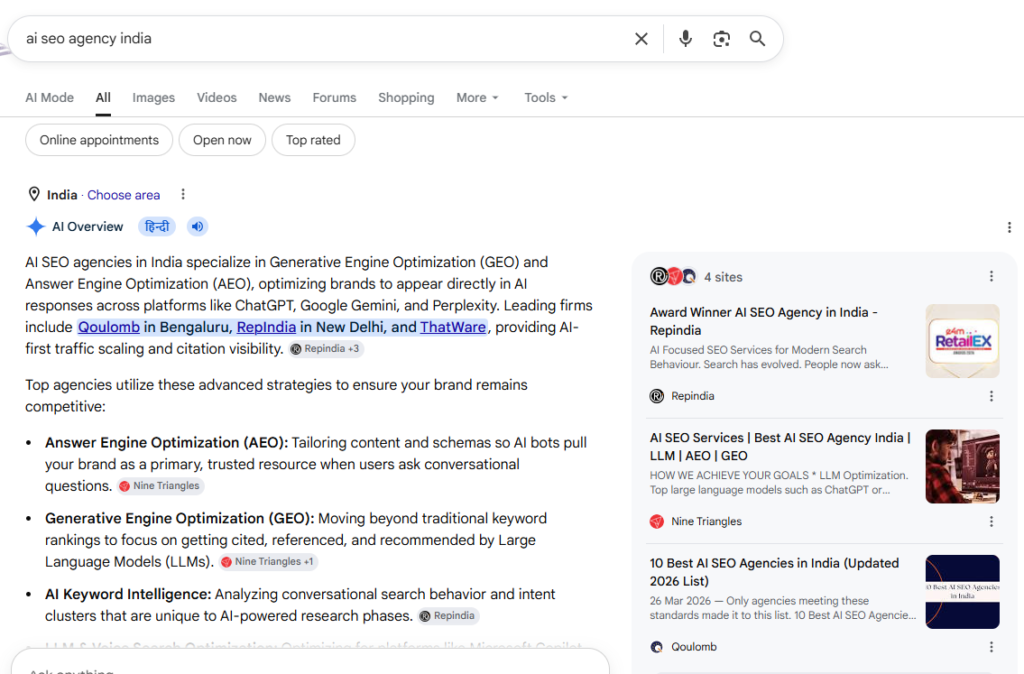
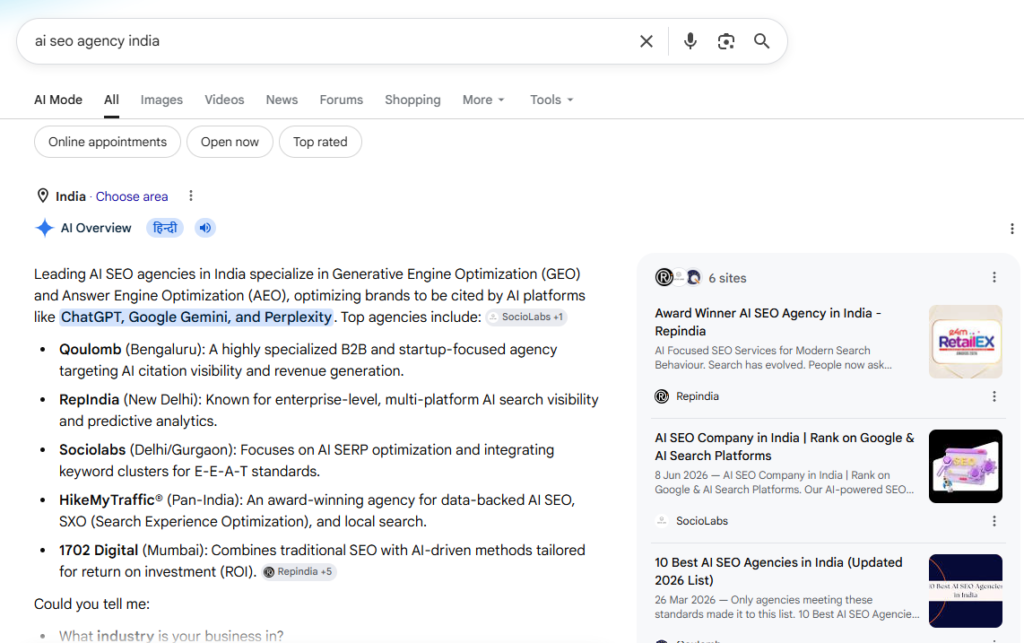
The two screenshots above show the same prompt tested less than a minute apart — and they reveal two different results. In the first, Google AI Overviews recommended websites with links, followed by the strategies brands use. In the second, the AI Overview led with the strategies, followed by a list of SEO agencies with no links.
Comparing ChatGPT AI Visibility With Other AI Tools (e.g., Gemini, Google AI Overviews)
AI answer engines differ on three objective criteria: retrieval index, citation behavior, and what content signals they reward.
| Criteria | ChatGPT | Google AI Overviews / Gemini | Perplexity |
|---|---|---|---|
| Retrieval index | Bing’s index plus OpenAI’s own crawling (OAI-SearchBot) | Google’s index and ranking systems | Its own crawler (PerplexityBot) plus search partnerships |
| When it cites | Cites when web search fires; often no citations on training-data answers | AI Overviews always link sources; placement tracks Google rankings | Cites sources on every answer by design |
| Link to existing rankings | Pages ranking #1 in Google were cited 43.2% of the time — 3.5x more than pages beyond the top 20 | Very strong — AI Overview sources skew toward top organic results | Moderate — freshness and fact density can outrank authority |
| Strongest lever | Bing visibility, answer-first content, third-party corroboration | Traditional Google SEO, E-E-A-T, snippet-style formatting | Fresh, fact-dense pages; frequent crawl access |
Key Reasons ChatGPT doesn’t cite Your Brand
1. Lack of Topical Authority or Recognized Expertise
ChatGPT favors sites it has seen repeatedly as trusted sources on a topic. A site with two blog posts about CRM software has no real presence on the subject. A site with 10–15 interlinked articles – covering CRM selection, migration, pricing, and integrations – does.
2. Inadequate Web Presence or Thin Content
Short pages rarely get cited, and the data is specific. A 400-word post on a topic gives the model nothing specific to extract or attribute to it.
Thin content means the absence of content from a third-party website. No review-platform profiles, no directory listings, no press coverage, no community discussion – each gap removes a surface where ChatGPT could encounter and corroborate your brand.
3. Schema Markup and Structured Data Gaps
Structured data tells machines what your content is, not just what it says. Without an Organization, Article, FAQPage, Product, or Review schema, the model has to guess what your page is about and who is behind it – and it often guesses wrong, especially if your brand name is also a common word.
Schema also helps AI tell you apart from everything else on the web. Consistent Organization markup – with sameAs links to your social profiles, your Wikipedia/Wikidata entry (if you have one), and key directories – helps AI systems connect scattered mentions of your brand into a single, clear identity.
4. Your Content Is Blocked from AI Crawlers
Many sites mistakenly block GPTBot, OAI-SearchBot, or other AI user agents in robots.txt – sometimes deliberately, often through inherited defaults or via a CDN’s bot-protection rules. If OAI-SearchBot cannot fetch your pages, you cannot be cited from live retrieval, regardless of content quality.
5. Weak Bing Presence
ChatGPT’s live search runs on Bing’s index. If your site has never been verified in Bing Webmaster Tools, has no sitemap submitted there, or ranks poorly on Bing for your category keywords, you start the race from the back. Most brands have spent years optimizing for Google and zero hours on Bing – and for ChatGPT visibility, that’s a real handicap.
6. Keep Your Answers Short
If your page opens with “Pricing depends on many variables” and doesn’t give actual numbers until paragraph nine, ChatGPT finds nothing worth quoting at first. Pages that answer the heading’s question within the first 40–60 words are selected and skipped.
7. Few Third-Party Mentions to Build Authority
If your site says you’re a leading vendor and no one claims or mentions you, that’s uncorroborated marketing copy. Brands that appear in “best of” lists, comparison articles, community threads, and industry publications provide ChatGPT with multiple independent signals pointing to the same entity, which are more likely to appear in ChatGPT’s answers.
8. Stale Content
Freshness matters when ChatGPT searches the web. A detailed guide last updated in 2023 will lose to a thinner but recent page with solid citations. Two things help: visible publish and update dates, and facts that are actually refreshed. Changing the date without changing the content doesn’t work – it’s easy to detect and can hurt your credibility.
Optimizing Your Website for Recommendations in ChatGPT Answers
The fixes below cover the ChatGPT-specific layer. For the broader playbook, see our guide to optimizing content for AI search engines.
Structured Data, Schema, and Technical SEO Essentials
Implement, in priority order:
- Organization schema, Article schema, FAQPage schema on pages with genuine question-answer sections
- Product and Review/AggregateRating schema where applicable.
- Clean semantic HTML: single H1 heading, descriptive H2/H3 hierarchy, real <table> elements for comparisons, lists marked up as lists.
Technical SEO: fast server response time, content rendered in HTML (not client-side JavaScript only), descriptive URL slugs, and an XML sitemap submitted to both Google Search Console and Bing Webmaster Tools.
Ensuring Accessibility to AI Crawlers and Bots
- Open robots.txt and confirm you are not blocking GPTBot (training), OAI-SearchBot (ChatGPT search retrieval), or ChatGPT-User (user-initiated browsing).
- Check your CDN/WAF (Cloudflare, Akamai, etc.) bot-management rules – they often challenge or block AI crawlers even when robots.txt allows them.
- Add an llms.txt file, similar to robots.txt, that lists your key pages and informs AI engines about your website’s important pages.
Targeting Informational Queries and Featured Snippets
- ChatGPT’s extraction behavior mirrors the logic of featured snippets: it pulls concise, self-contained answers from directly under question-format headings.
- Write H2s/H3s as the questions users actually ask (“How much does X cost?”, “Is X better than Y for Z?”).
- Answer in the first one to two sentences under each heading, then expand.
- Front-load: the opening 30% of the page should contain your most citable claims – that’s where 44.2% of citations come from – ideally including a TL;DR or summary block.
- Add People Also Ask questions for the exact phrasings to target.
Building High-Quality Backlinks and Brand Mentions
For AI visibility, where a link sits matters more than how many you have. The best targets are pages ChatGPT already cites – comparison articles, “best of” roundups, review platform pages. Five of those beat fifty directory links. Mentions without a link count too; ChatGPT reads them either way.
Run your niche prompts through ChatGPT and Google with web search enabled, note which third-party pages are cited repeatedly, and try to get published on third-party websites. Quora and Reddit communities are best for natural placement.
Leveraging Multi-Format Content for Enhanced AI Signals
AI answer engines increasingly draw on more than article text. YouTube transcripts are parsed and cited; podcast show notes and transcripts are indexable; original images and diagrams with descriptive alt text reinforce entity-topic associations.
At Redefine ROI, we turn one blog post into many formats: an infographic, a podcast episode, a Medium post, a LinkedIn carousel, Pinterest pins, 3–5 short videos, and one long video. One topic, spread across every channel – so the same claims exist on multiple surfaces that AI engines can find.
Important FAQs
The fastest way to get cited by ChatGPT is to appear on third-party pages it already uses as sources. These include comparison articles, “best of” roundups, and review platforms in your category. This earns AI citations faster than building your own domain authority, which takes months.
1. Run your buyer prompts in ChatGPT with web search enabled. Note which pages it cites repeatedly.
2. Pitch your content to get your brand included in those exact pages.
3. Restructure key pages to answer questions in the first two sentences under each heading.
Yes. Traditional SEO directly improves AI search visibility, but it is not enough on its own. Strong Google and Bing rankings raise your chances of being cited by ChatGPT, Gemini, and AI Overviews. AI engines reuse search indexes, so crawlability, backlinks, and topical authority still count.
1. Google rankings strongly influence Gemini and AI Overviews. Bing rankings influence ChatGPT.
2. Structured data, E-E-A-T signals, and quality backlinks feed AI retrieval systems.
3. What classic SEO misses: Bing optimization, AI crawler access, and answer-first formatting.
If you’re evaluating AI SEO optimization services or generative engine optimization (GEO), see how we audit citation gaps and benchmark your brand’s share of AI answers against competitors.
You can check brand mentions in ChatGPT in three ways: manually prompting, using analytics, and using AI visibility-tracking tools. Manual checks give a quick signal. Tracking tools provide reliable trends because ChatGPT’s answers vary across sessions. A single test proves little — measure across many prompts over time.
1. Manual: ask your buyer questions in ChatGPT with web search on. Run each prompt several times.
2. Analytics: Look for referral traffic from chatgpt.com in your analytics platform.
3. Server logs: check for OAI-SearchBot and ChatGPT-User hits. Crawling comes before citing.
4. Tracking tools such as Profound, Otterly.AI, Semrush AI Toolkit, and Ahrefs Brand Radar sample hundreds of prompts on a schedule.
5. Track both mentions (your brand name) and citations (your URL linked). They are different signals.